If you’ve ever shopped for a replacement starter for your boat, you’ve probably noticed the price gap. An automotive starter runs about $120. A marine-certified one? Closer to $275. Same engine family, similar look, fits the same bolt pattern.
So what gives?
The short answer is safety. The longer answer involves gasoline fumes, enclosed engine compartments, and a certification that exists for a very good reason. We put together a tech tip video (above) breaking it all down, and it’s one of those topics every stern drive owner should understand, especially if you bought used.
⛵ What Does “Ignition Protected” Actually Mean?
A marine-certified starter carries an SAE certification that confirms it’s safe to operate in an environment where flammable hydrocarbons (gasoline fumes) may be present. That certification is called ignition protected.
In a car, this isn’t really a concern. Any fumes that exist around the engine drop down and dissipate underneath the vehicle. Open air handles the rest.
A boat is a completely different situation. Gasoline fumes from an old fuel hose, a carburetor, or even just normal engine operation cycle downward and collect in the bilge. There’s nowhere for them to go. They sit there, invisible, until something either ventilates them out or ignites them.
A marine-certified starter is designed so that its operation won’t spark those fumes. An automotive starter? No such guarantee.
🔧 The Two Starters Side by Side
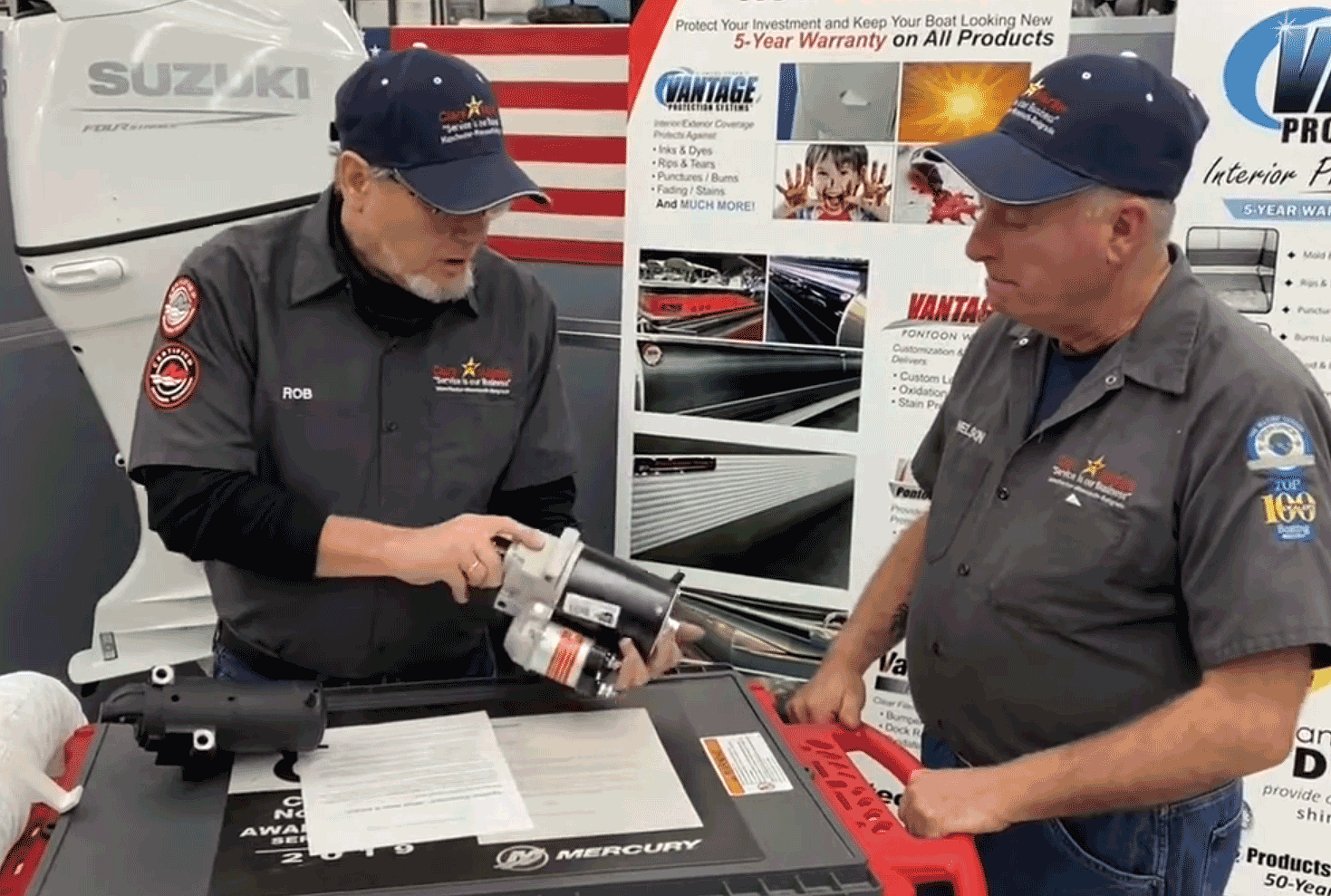
Side by side, these two starters look almost identical. Both are GM-style offset starters, the kind you’d see on a 3.0, 4.3, 5.0, or 5.7 stern drive engine. The marine version is slightly larger in the body, but the real difference isn’t something you’d catch at a glance.
The marine starter has the SAE ignition-protected certification stamped right on it. The automotive one doesn’t. And it doesn’t need to, because cars don’t trap fumes in an enclosed space the way boats do.
💨 The Bilge Blower: Your Other Line of Defense
Along with the starter, there’s another critical component that often gets overlooked on used boats: the bilge blower.
This is a fan that sits underneath the motor, connected by a hose to the engine compartment. Before you start the engine, you’re supposed to turn the blower on and let it run for a few minutes. It pulls any accumulated fumes out of the bilge so they’re not sitting there when the starter fires.
On a used boat that’s been sitting in someone’s backyard for a few years? The blower may not work at all. And if you’re new to boating, you might not even know to look for it.
🚨 Why This Matters More Right Now
For every new boat sold, roughly four used boats change hands, and most of those sales happen driveway to driveway. No dealer inspection, no service check, no one verifying that the starter is marine-grade or that the blower still functions.
A lot of boats that sat dormant for years are getting pulled out of garages and backyards. Some are being sold, some are being recommissioned by their owners. Either way, the safety components deserve a close look before that engine turns over for the first time in a long time.
✅ What to Check If You’re Buying (or Reviving) a Used Stern Drive
- Look for the SAE ignition-protected certification on the starter. If it’s not there, you’re likely looking at an automotive replacement that someone installed to save money.
- Test the bilge blower. Turn the key to the accessory position and flip the blower switch. If nothing happens, that’s a problem that needs fixing before you start the engine.
- Don’t let price be the deciding factor. Yes, $275 is more than $120. But your family is going to be in this boat. Something going wrong here could change your day, your week, your year.
- If you’re not sure what you’re looking at, ask. Our service team is happy to do a quick inspection or walk you through what to check. You can submit a service request online or give us a call.
🛠️ DIY-Friendly, Too
If you want to buy a marine-grade starter and install it yourself, we’ll sell you the part and help walk you through the install. We’ve got a library of resources on-site, and we’re genuinely happy to coach you through it.
Not every shop operates that way. It’s one of the things that makes us a little different, and it’s a big part of why our customers keep coming back.
❓ Frequently Asked Questions
- Can I use an automotive starter on my boat? Technically, yes. It will bolt up and the engine will turn over. But an automotive starter is not ignition protected, which means it’s not certified for use in environments where gasoline fumes may be present. On a boat, where fumes collect in the bilge, that’s a real safety risk.
- How do I know if my boat has a marine-grade starter? Look for the SAE ignition-protected certification on the starter itself. If there’s no certification label, it’s likely an automotive unit.
- What does a bilge blower do and why does it matter? The bilge blower is a fan that ventilates gasoline fumes out of the engine compartment before you start the motor. Running it for a few minutes before ignition is a standard safety step, especially on stern drive boats with enclosed engine bays.
- How much more does a marine starter cost compared to automotive? Expect to pay roughly double. A typical automotive starter runs around $120, while a marine-certified one is closer to $275. The price difference pays for ignition-protected certification and the engineering behind it.
- What should I check before buying a used stern drive boat? At minimum, verify the starter is marine-grade and the bilge blower works. Those are two of the most commonly overlooked safety items on used boats, especially ones sold privately. For a more thorough evaluation, our service team can help.