Most boat shoppers focus on what’s above deck: the furniture, the layout, the features. But the real difference between an Avalon pontoon that lasts and one that doesn’t? It’s underneath.
🔩 Built to Last: What’s Under the Deck
The Nose Cone
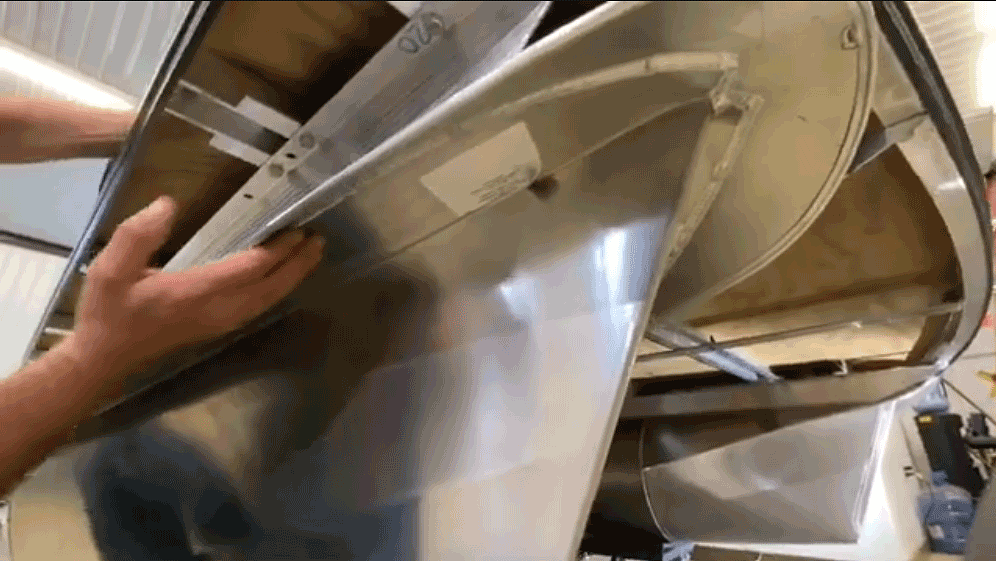
Avalon’s nose cone is one of the strongest in the industry, and it starts with how it’s made. It’s a single piece of aluminum, machine-formed and folded rather than welded together from multiple parts. The integrated splash fins are part of that same piece, not welded on as an afterthought like some competitors do.
The aluminum is 100 thousandths thick, and where it folds over, you get double thickness: 200 thousandths, or just shy of 3/16 of an inch. That’s serious material. The edge guards are welded in strategic areas so they can’t come off. Some manufacturers press-fit theirs, but Avalon welds them to make sure they stay put.
The M-Riser System
Look inside an Avalon pontoon tube and you’ll see what they call a full-length M-riser. It’s shaped like an M, runs the entire length of the tube, and is welded in strategic areas on both sides and the top. This stiffens the log significantly, making it one of the stiffest in the industry.
The risers are through-bolted to channels that run the full 8.5-foot width of the deck. Some manufacturers cut costs by running channels only 8 feet across. Avalon doesn’t. That extra half foot of channel makes the whole boat more structurally stable.
The Side Protector Keel
Most pontoons have a keel on the bottom to help with tracking. Avalon adds one on the side too, and it serves a different purpose: dock protection.
Think of a pontoon tube like a soda can. If you crush the side, the structural integrity is gone. That side keel acts as the first line of defense against your dock. It sits out slightly from the rub rail, so the keel takes the hit first. And if it ever needs to be replaced, it can be cut off and swapped out much easier than the rub rail itself.
The Baffle System
Every Avalon tube is divided into separate compartments by welded baffles. You can see small creases on the outside where each baffle is welded in place on the inside.
This creates multiple sealed sections: the nose cone compartment, midship, mid-stern, and full stern. If you ever did have a leak, it would be contained to one section rather than flooding the whole tube.
🔧 The Small Details That Add Up
Beyond the big structural features, a few smaller details show how Avalon thinks about the long game.
Spun Caps
The rear caps are spun on a die rather than stamped. This creates a spiral pattern that adds structural strength compared to a smooth stamped piece.
Tow Hook
There’s a heavy-duty secondary tow hook that could practically lift the boat (though we don’t recommend testing that).
Drain Plug
Every tube has a drain plug. You’d be surprised how many manufacturers skip this. But if you ever hit a rock and poke a hole, how are you supposed to get the water out? With Avalon, you can drain it, find the leak with a pressure test, and bring it in for pontoon service without drilling into your tube.
⚓ See It for Yourself
These aren’t flashy features. You won’t find them in a brochure. But they’re the reason an Avalon holds up season after season with proper winterization and off-season repairs. Want to see the difference in person? Stop by Clark Marine and we’ll take you under the deck.
Frequently Asked Questions
1. What makes Avalon pontoons better than other brands?
Avalon builds with structural features most manufacturers skip or cut corners on. That includes single-piece machine-formed nose cones, full-length M-risers welded inside the tubes, side protector keels for dock impact, and a baffle system that compartmentalizes each tube so a single leak doesn’t flood the whole log.
2. Are Avalon pontoons good for freshwater lakes in Maine?
Yes. Avalon builds exclusively for freshwater and saltwater durability. The construction quality holds up well in Maine’s conditions, including rocky lake bottoms and seasonal weather. Clark Marine is an authorized Avalon dealer with current Avalon inventory available to view.
3. What is the M-riser system in an Avalon pontoon?
The M-riser is a structural reinforcement shaped like the letter M that runs the full length of each pontoon tube. It’s welded on both sides and the top, and it stiffens the tube significantly. The risers are through-bolted to full-width deck channels, which adds stability across the entire boat.
4. How does the baffle system work in Avalon pontoon tubes?
Each tube is divided into sealed compartments by welded baffles. If one section is ever punctured, water stays contained in that compartment instead of filling the entire tube. Each section also has a drain plug so you can empty it and pressure-test for leaks without drilling into the tube.
5. Can I see an Avalon pontoon in person at Clark Marine?
Absolutely. We keep Avalon pontoons on the lot at our Manchester location and are happy to walk you through the construction details in person. Reach out to schedule a visit and we’ll take you under the deck.