
You’re at the auto parts store. You spot a quart of 10W-30 for $4.99. Your outboard takes 10W-30. Seems like a no-brainer.
It isn’t.
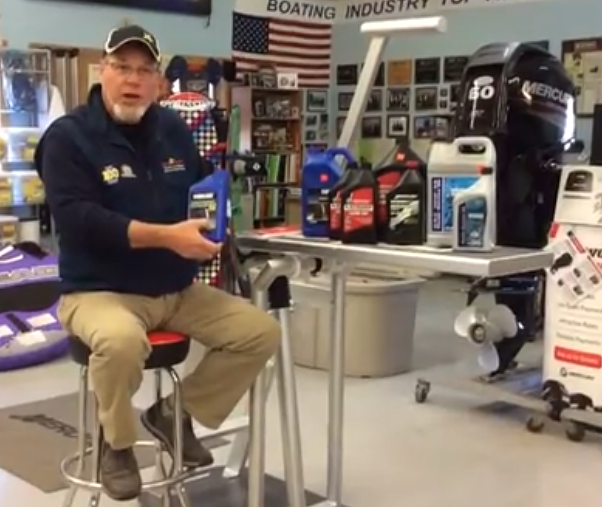
Marine oil and automotive oil share a viscosity rating and not much else. Rob Brown covered this in a recent Rob’s Vlog, and it’s the kind of thing that sounds like a minor detail until you realize the wrong oil can shorten the life of a motor you paid thousands of dollars for.
🔩 Why Marine Engines Are a Different Animal
Your car engine and your outboard both need oil. That’s where the similarity ends. Marine engines operate in conditions that would be unusual for any automotive application, and the oil has to account for all of them.
For starters, marine engines run at much higher RPMs. Where your car might cruise the highway at 2,000 to 2,500 RPMs, an outboard or stern drive is regularly spinning between 4,500 and 6,000. That kind of sustained speed creates what Rob describes as a shear effect on the oil molecules, breaking them down faster than automotive oil is formulated to handle. Marine oils are built with additives specifically designed to resist that breakdown so you’re not losing viscosity when the engine needs it most.
Temperature is another factor. Automotive engines typically run around 210 degrees. Marine engines run cooler, usually 160 degrees or below, and there’s a reason for that. In saltwater applications, anything above 170 degrees risks crystallizing salt deposits in the cooling passages and shutting down the cooling system entirely. Marine oil has to flow and lubricate properly at those lower temperatures, which requires a different formulation than what keeps your car running.
Then there’s moisture. Marine engines are constantly drawing air with high humidity through the intake and into the crankcase. Without the right additive package to fight corrosion from the inside, the engine starts eating itself. Automotive oils aren’t built for that environment.
Finally, load. Rob puts it plainly: running an outboard on a towboat is roughly equivalent to driving your truck up a steep hill at 80 miles per hour, continuously. The load demands require oil that can maintain its protective properties under that kind of sustained stress.
🏷️ How Marine Oil Gets Certified
Automotive oils are rated by the Society of Automotive Engineers (SAE) and you’ll see that designation on every bottle. Marine four-stroke oils are certified by a different body: the National Marine Manufacturers Association (NMMA).
When you’re shopping for marine oil, look for the NMMA certification label. It’s a diamond-shaped logo on the bottle. That label tells you the oil has been tested and certified to meet the minimum standards for marine use, including the additive packages that protect against corrosion, shear, and the demands of running at high RPMs in a wet environment.
If the bottle only shows the SAE rating and no NMMA certification, it’s automotive oil. Put it back.
🛢️ So Which Oil Should You Actually Buy?
Our recommendation is straightforward: start with the brand your engine is from. The engine manufacturer knows what’s in the oil they make, and it’s formulated for how that specific engine runs.
From there, check your owner’s manual. It will tell you exactly what viscosity to use. Many four-stroke marine engines call for a 25W-40 synthetic blend as the first choice. In cooler climates like Maine, where high-temperature operation isn’t the primary concern, a quality 10W-30 is often listed as an acceptable alternative.
The same logic applies to oil filters. Go with the OEM filter for your engine, not an aftermarket equivalent. It’s a small cost difference and a meaningful one for long-term protection.
📋 Quick Reference: What to Look For
When you’re shopping for marine oil:
- Look for the NMMA certification diamond on the label
- Match the brand to your engine manufacturer when possible
- Check your owner’s manual for the recommended viscosity
- In cooler regions, a quality 10W-30 is often an acceptable alternative to 25W-40
- Use an OEM oil filter, not a generic substitute
What to avoid:
- Standard automotive oil, even if the viscosity matches
- Any oil without the NMMA certification label
- Aftermarket filters that aren’t rated for your engine
⚓ Not Sure What Your Engine Takes?
Bring your owner’s manual in or just stop by and ask. We’re happy to point you toward the right oil and filter for your specific engine. Reach out to us or schedule a service appointment and we’ll make sure you’re set up right before the season starts. There’s a reason people choose Clark Marine, and this kind of straightforward advice is a big part of it.
Frequently Asked Questions
Can I use automotive oil in my outboard motor?
No. Automotive oil isn’t formulated for the conditions marine engines deal with: higher RPMs, lower operating temperatures, constant moisture in the crankcase, and sustained heavy load. Using automotive oil will reduce the life of your engine.
What’s the difference between marine oil and regular oil?
Marine oil contains additive packages designed specifically for saltwater and freshwater environments, high RPM operation, moisture resistance, and the shear forces outboard engines experience. Automotive oil is rated by the SAE for car engines. Marine four-stroke oil is certified by the NMMA and built to a different standard.
How do I know which oil to use in my outboard?
Start with your owner’s manual. It will specify both the recommended viscosity and the oil type. Use oil from the same brand as your engine when possible, and look for the NMMA certification diamond on the label. If you’re in a cooler climate, a quality 10W-30 is often acceptable when the manual lists it as an alternative.
Does it matter which oil filter I use?
Yes. OEM filters are designed and tested for your specific engine. Aftermarket filters may look similar but can vary in materials, bypass pressure, and filtration quality. Stick with the manufacturer’s filter for the best protection.
How often should I change the oil in my outboard?
Follow your owner’s manual for the recommended interval. At minimum, most manufacturers recommend changing oil and the filter at the start of each season. If you’re doing proper boat winterization, an oil change is a good item to include in that process as well.