Pontoon vs. Tritoon: Which Is Better for Maine Lakes? A Master Technician Explains.
Rob's Boat Buyer's Guide | Part 3
By Rob Brown, Master Marine Technician | Over 45 Years in the Boating Industry
Two pontoons or three?
It's one of the most common questions we hear from people shopping for a new pontoon boat. And after 45 years in the marine industry, I can tell you that the answer isn't as simple as you might think.
A tritoon isn't automatically better because it has three tubes. A pontoon isn't necessarily a better choice because it has two.
And if you ask me about express tubes, well, you'd better pull up a chair.
I've spent decades selling, servicing, operating, and repairing boats. At Clark Marine, we've represented Avalon Pontoons since 1998, and we've had the opportunity to see how these boats age, what works, and what happens when certain design decisions don't work quite as well as intended.
So, if you're trying to decide between a pontoon and a tritoon for your Maine lake, here's what I want you to understand before you buy.
Key Takeaways: Pontoon vs. Tritoon
- Two tubes aren't necessarily worse than three. A properly equipped twin-tube pontoon can be an excellent choice for cruising, relaxing, and family boating.
- Tritoons offer additional capabilities. Depending on the design, a third tube can improve buoyancy, carrying capacity, handling, and performance.
- Not all center tubes are created equal. I'm a strong believer in properly engineered full-length center tubes, and I've got some expensive repair experiences to explain why.
- Horsepower matters, in both directions. You don't want an underpowered boat, but buying more horsepower than you'll realistically use isn't necessarily the answer either.
- How you operate your engine matters. Fuel-system problems are the number one engine issue we encounter during the summer at Clark Marine.
- Your lake matters. What works beautifully on a small protected pond may not be ideal for the open water of Great Pond, Sebago, or Moosehead.
- A boat shrinks in the water. Don't let a 25-foot tritoon intimidate you just because it looks enormous sitting in a dealership lot.
- Three tubes can mean higher ownership costs. Bottom cleaning, engines, storage, and trailers can all influence your long-term expenses.
My biggest piece of advice? Buy the configuration you actually need, and make sure the entire boat-and-motor package is designed to work together.
First, What's the Difference Between a Pontoon and a Tritoon?
Let's start with the basics.
A traditional pontoon boat has two flotation tubes underneath the deck.
A tritoon has three.
Simple enough.
But the real difference isn't just the extra aluminum.
The third tube can change how the boat floats, carries weight, turns, accelerates, and responds to different water conditions.
Depending on the design, tritoons can also accommodate higher horsepower ratings and more substantial performance packages.
That can make a meaningful difference for families who regularly carry larger groups, enjoy water sports, or spend time on bigger lakes.
But there's a catch.
The third tube is only as good as the engineering behind it.
And we'll get to that in a moment.
Pontoon vs. Tritoon: A Quick Comparison
FeatureTwo-Tube PontoonThree-Tube TritoonBest suited forRelaxed cruising, smaller groups, many protected lakesLarger groups, performance applications, more exposed lakesPassenger capacityDepends on model and ratingsOften offers greater capacity, depending on designHorsepowerCommonly paired with smaller or moderate-power enginesOften supports higher-horsepower configurationsHandlingComfortable cruising, dependent on hull designCan offer improved handling at higher speedsWater sportsSuitable when properly equipped and ratedOften preferred for more demanding towing activitiesBottom cleaningTwo tubes to cleanThree tubes to cleanOwnership considerationsOften simpler with smaller packagesPotentially higher cleaning, storage, fuel, and service expenses
These are general differences, not promises about how every boat will perform.
I've seen some terrific twin-tube boats, and I've seen three-tube boats that weren't configured particularly well.
That's why I look at the entire package instead of making recommendations based strictly on the number of tubes.
When Would I Recommend a Traditional Two-Tube Pontoon?
More often than you might expect.
Let's say you're a couple who primarily enjoys cruising around a smaller lake.
You like taking an evening ride, bringing a few friends along, finding a quiet place to swim, and spending time on the water.
You're not particularly interested in towing tubes every weekend.
You don't regularly fill the boat to capacity.
And you're not crossing miles of open water in challenging conditions.
Well, you may be perfectly happy with a properly equipped twin-tube pontoon.
And there's absolutely nothing wrong with that.
In fact, we've sold many approximately 21-foot twin-tube pontoons with 115-horsepower outboards.
For the right customer, that's been a terrific combination.
It's comfortable, versatile, and capable of doing an awful lot of enjoyable family boating.
You don't need to buy a tritoon just because somebody told you three tubes are better.
You need to buy the boat that's right for your family.
When Is a Tritoon Worth It?
Now, there are plenty of situations where I absolutely love a properly configured tritoon.
Maybe you regularly carry eight or ten people.
Maybe the grandchildren have discovered tubing and have every intention of spending the entire summer behind the boat.
Maybe you're boating on a larger lake where you want a more substantial hull configuration and greater performance capabilities.
Or maybe you simply want a larger, more versatile boat that will accommodate your changing needs over time.
Those are all good reasons to explore a tritoon.
With the right engineering, a center tube can provide additional buoyancy and contribute to improved load-carrying and handling characteristics.
Many tritoon configurations also allow for more substantial horsepower packages, which can be especially helpful when you're carrying passengers or enjoying water sports.
One combination I've particularly liked over the years is a properly equipped 21-foot tritoon with a 150-horsepower outboard, where the manufacturer's ratings permit it.
Now, I'm not saying every 21-foot tritoon needs 150 horsepower.
I'm saying I've seen that combination work very well for the right family.
And that's the point.
I want enough boat and enough motor to do what you expect—without automatically selling you more than you need.
Express Tubes? Absolutely Not. Here's Why.
Now we're getting into something I feel rather strongly about.
And my family is probably rolling their eyes already.
If you're considering adding a third tube, my preference is straightforward:
Buy a properly engineered full-length center tube, or stick with two.
I'm not a fan of express tubes.
Not even a little.
And this isn't because I simply dislike the idea.
It's because we've had to deal with the consequences.
We've Seen the Problems Firsthand
At Clark Marine, we've performed tens of thousands of dollars in repairs addressing problems involving certain shortened-center-tube configurations across more than one boat brand.
And these haven't been isolated concerns.
We've encountered recurring problems involving the way water moves beneath some of these boats and interacts with the outboard motor.
Depending on the design, boat speed, motor installation, and operating conditions, disturbed water flow and excessive spray around the engine can create serious problems.
And when that happens, we're not necessarily talking about losing a couple of miles per hour.
We're talking about issues that can become considerably more expensive.
We've encountered situations involving water intrusion and severe engine damage, including a seized powerhead.
That is not the kind of surprise anybody wants at the end of a beautiful summer afternoon.
And after working through expensive repairs associated with these configurations, I've developed a very healthy skepticism.
Why I Prefer a Full-Length Center Tube
A properly engineered full-length center tube gives the manufacturer the opportunity to design the boat's flotation, performance, and water flow as a complete system.
That's what I'm looking for.
I want the tubes, lifting surfaces, engine mounting, and water flow to work together.
And I don't want to recommend a configuration that has repeatedly caused us trouble in the service department.
Does that mean every express-tube boat is going to have a problem?
Of course not.
Different manufacturers have used different designs, and the circumstances matter.
But my recommendations are informed by what I've personally seen and repaired.
And after you've watched expensive construction issues turn into even more expensive engine problems, it becomes pretty difficult to ignore the experience.
There are plenty of things I'll compromise on when helping somebody buy a boat. This isn't one of them.
Let's Talk Horsepower: More Isn't Always Better.
Now, here's another subject where people tend to get carried away.
Some buyers want the largest motor the boat will accept.
Others want to install the smallest motor available because they assume it'll be sufficient.
I don't particularly love either approach.
The correct horsepower depends on the boat, passenger load, intended activities, and the characteristics of the outboard itself.
Every manufacturer approaches engine design a little differently.
Two outboards with the same rated horsepower can behave differently because of gearing, propeller selection, displacement, and other engineering details.
That's why I don't like making horsepower recommendations based entirely on a number.
Don't Underpower the Boat.
If you tell me you're buying a pontoon to carry a crowd and spend the summer towing tubes, we're going to take that into consideration.
A motor that moves a lightly loaded boat around the lake isn't necessarily going to deliver the performance you want when the boat is full of passengers.
And I don't want you discovering that after you've bought it.
In fact, one of the three biggest reasons I've seen people trade pontoons is because they didn't purchase enough horsepower in the first place.
The other two?
Not enough room and not enough pontoons.
Funny how these things tend to come back around.
One Experience I'll Never Forget
Roughly 30 years ago, I was operating a 24-foot Harris service pontoon with a 40-horsepower outboard.
The boat had hardly any furniture aboard.
We weren't exactly carrying a tremendous amount of weight.
But the wind picked up and started pushing us toward a rocky shoreline.
And I had nearly everything I could do to keep the boat away from those rocks.
That's an experience that stays with you.
And it's one of the reasons I take the relationship between boat size, horsepower, and operating conditions so seriously.
The motor has to be appropriate for the boat and the environment. Not just for a calm afternoon with two people aboard.
But There Is Such a Thing as Too Much Horsepower.
Here's something you might not expect to hear from a boat dealer.
I don't necessarily want to sell you the biggest motor available.
Why?
Because bigger isn't always better, particularly when it comes to how you're actually going to use that engine.
At Clark Marine, fuel-system problems are the number one engine issue we encounter during the summer.
And in our experience, the overwhelming majority of those problems are associated with poor-quality fuel or inappropriate engine use.
We've spent countless hours diagnosing fuel-system problems that might have been avoided with better fuel management, proper maintenance, and operating habits.
An outboard that spends its entire life operating at very low speeds may face different maintenance challenges than one that's regularly operated across an appropriate range of RPMs.
That doesn't mean running at full throttle all afternoon.
And it certainly doesn't mean a hard run is a substitute for cleaning dirty fuel injectors or maintaining your fuel system.
But I do want customers to understand how their engines are designed to operate.
New outboards have manufacturer-specific break-in procedures. Those instructions often call for varying engine speed and observing particular throttle limits during the initial hours of operation.
Once the engine is properly broken in, we also want to make sure it's correctly propped and capable of reaching the manufacturer's specified operating RPM range under appropriate test conditions.
That doesn't mean you have to drive everywhere at maximum throttle.
It means the entire boat-and-engine package needs to be properly configured, and the owner needs to understand how to operate and maintain it.
If your idea of a wonderful afternoon is slowly cruising around the lake with your spouse, I don't necessarily want to put an enormous outboard on the back of your boat simply because the manufacturer allows it.
On the other hand, if you're regularly carrying a full boatload of people and pulling the grandchildren around on a tube, I want to make sure you're not struggling with an underpowered engine.
It's a balancing act.
And after more than 45 years working on boats, I can promise you that getting that balance right matters.
Buy enough horsepower to do everything you want comfortably. But don't assume the biggest engine is automatically the best engine for you.
Which Is Better for Maine Lakes?
This is where being a local dealership really comes into play.
Maine has an incredible variety of lakes, ponds, and waterways.
And they don't all call for the same boat.
A pontoon that works beautifully on a protected pond outside Monmouth may not be my first recommendation for someone planning to regularly cross the open water of Moosehead.
Likewise, someone navigating narrower waterways may have very different priorities than a family spending its weekends cruising Great Pond.
Cobbosseecontee Lake and the Winthrop Lakes Region
For people boating on Cobbosseecontee Lake and the surrounding Winthrop-area lakes, I want to know exactly where they plan to operate.
How far are you traveling?
How many passengers are coming along?
Are you staying in protected areas or heading into more open water?
And what kind of dock or landing access do you have?
Those answers influence whether I'd recommend a twin-tube pontoon or a tritoon.
The Belgrade Lakes
The Belgrade Lakes region offers beautiful boating, but places like Great Pond can have considerable stretches of exposed water.
Wind and changing conditions deserve attention.
For families regularly carrying larger groups or traveling across more open water, I'd certainly want to discuss a properly equipped tritoon.
That doesn't mean every boat on Great Pond needs three tubes.
It means we need to match the boat to the actual conditions and the family's boating habits.
Sebago Lake and Moosehead Lake
Now we're talking about some substantial bodies of water.
On larger, more exposed lakes such as Sebago and Moosehead, I often start the conversation with substantial 25- or 27-foot tritoons.
That gives us a useful starting point for discussing boat configuration, horsepower, capacity, and comfort.
But a larger tritoon is not a guarantee of safety in difficult weather.
Every boat has operating limits, and good judgment remains essential.
We still need to consider the individual boat, the family's experience, their dock and access situation, and how they intend to use it.
A big lake deserves a boat that's appropriate for a big lake. But there's no substitute for knowing when to stay at the dock.
And While We're Talking About Big Boats, Remember: A Boat Shrinks in the Water.
This is something I tell people all the time.
A boat shrinks in the water.
Not literally, of course.
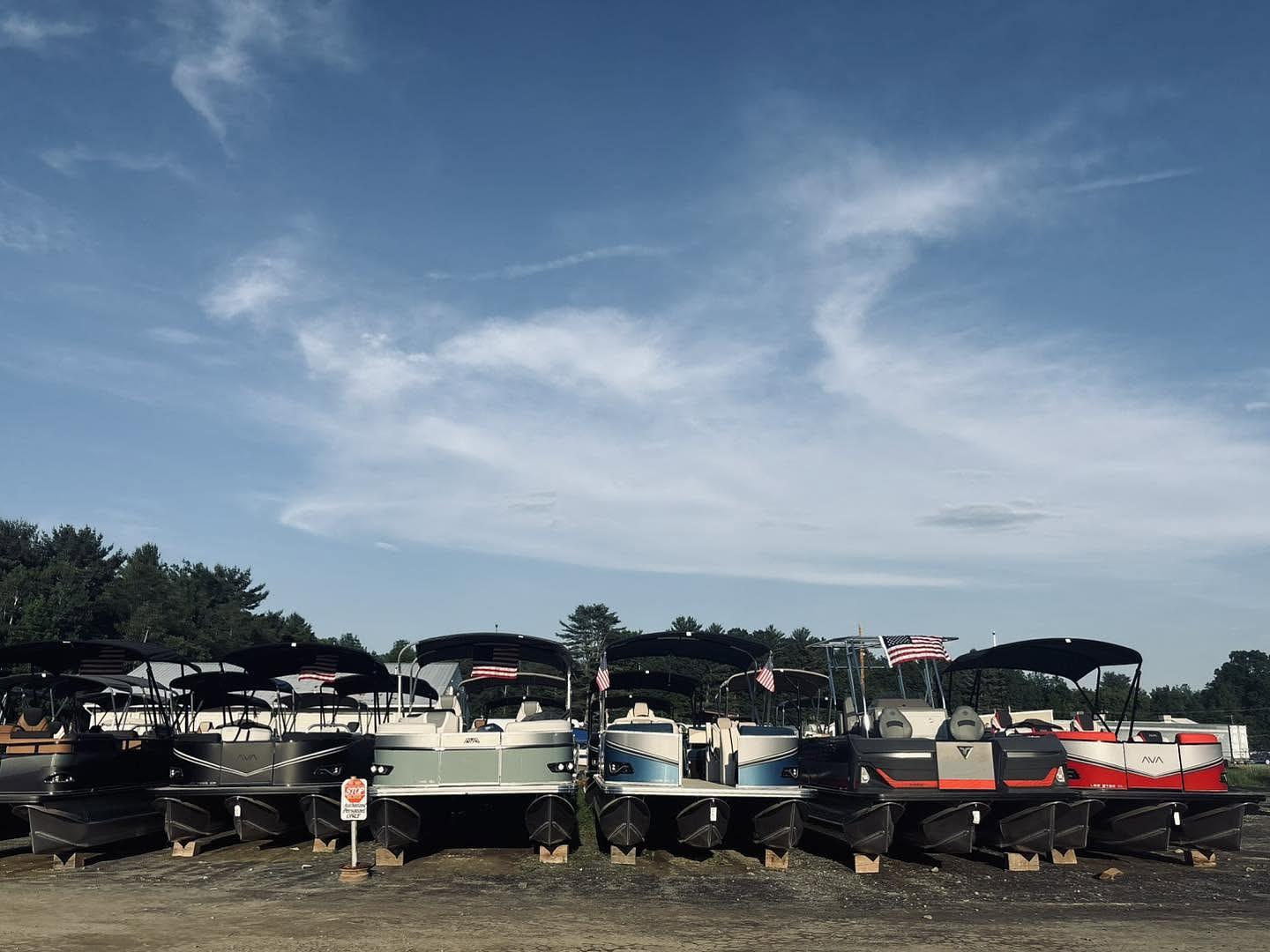
But a 25-foot pontoon sitting in our dealership lot can seem enormous.
You look at it and think, "Good grief, it's usually just the two of us. What would we do with something that big?"
Then you see that same boat out on Great Pond, Sebago, or Moosehead.
Suddenly, it looks perfectly at home.
You've got space to move around, room for friends and grandchildren when they visit, and a properly configured hull that can provide a comfortable ride.
Even if there are only two people aboard.
Now, I'm not suggesting everybody needs a 25-foot tritoon.
That would be ridiculous.
But I don't want people ruling out a boat simply because it looks enormous sitting on land.
Think about where you're going to use it.
Think about how it's going to feel on the water.
And think about whether you're choosing a boat you'll still be happy with a few years from now.
Because one of the other things I've learned is that people rarely complain about having a little extra room.
They do, however, complain when they don't have enough.
The Hidden Cost of That Third Tube
Now, before everybody goes running out to buy a 27-foot tritoon, let's discuss something else.
The cost of owning it.
And I'm not talking about the purchase price.
I'm talking about what happens every year afterward.
A tritoon generally costs more to bottom-clean because there's an additional tube.
A larger boat can cost more to store.
A larger outboard may require more fuel, more oil, and more expensive routine servicing, depending on the specific engine and how it's operated.
And if you're purchasing a trailer, that expense can change considerably with the boat's size and configuration.
At Clark Marine, we've seen situations where the difference in annual storage expenses between different pontoon packages can approach $1,000.
That's worth understanding before you make a decision.
Now, I don't want somebody buying an underpowered twin-tube pontoon just to save money.
That can be a rather expensive mistake, too.
But if a properly configured two-tube boat will comfortably accomplish everything you want, there's nothing wrong with choosing it.
The right boat isn't just the one you can afford to purchase. It's the one you can comfortably afford to own and enjoy.
And if you're interested in the details, I've got an entire article about the real cost of pontoon ownership in Maine.
Because apparently, my family thought one article about spending money wisely wasn't enough.
So, Should You Buy a Pontoon or a Tritoon?
After 45 years in the marine industry, here's how I would approach the decision.
I'd lean toward a traditional two-tube pontoon if:
- You primarily enjoy relaxed cruising.
- You usually carry smaller groups.
- You boat on a smaller or more protected lake.
- You don't have substantial performance or towing expectations.
- You want to keep ownership and maintenance considerations relatively simple.
I'd strongly consider a properly equipped tritoon if:
- You regularly carry larger groups of family and friends.
- You want more substantial performance capabilities.
- You frequently enjoy tubing or other approved water sports.
- You travel across larger, more exposed lakes.
- You want a boat with capabilities that may better accommodate your future boating plans.
But I wouldn't make the decision without discussing your horsepower, floor plan, lake, intended load, and the actual specifications of the boats you're comparing.
And I certainly wouldn't make it based solely on how many pontoons are underneath the deck.
Come Talk Tubes With Us. I'll Try Not to Get Carried Away.
Clark Marine has been helping Maine families enjoy boating since 1958, and we've represented Avalon Pontoons since 1998.
As a dealership that sells and services boats, we get to see what works, what lasts, and what customers wish they'd done differently.
That experience influences the boats we recommend and how we configure them.
Whether you're shopping for an Avalon pontoon or tritoon for Cobbosseecontee Lake, the Belgrade Lakes, Sebago, Moosehead, or one of Maine's many smaller ponds, we'd love to help you find the right combination.
Tell us about your family.
Tell us about your lake.
Tell us what you want to do with your boat.
And we'll help you decide whether two tubes or three make the most sense.
Explore Avalon pontoons at Clark Marine, or visit us in Manchester, Maine.
And if you ask me about express tubes, I'd suggest clearing your schedule.
— Rob Brown, Master Marine Technician, Clark Marine
Frequently Asked Questions About Pontoons and Tritoons
Is a tritoon better than a pontoon?
Not necessarily. A properly configured tritoon can offer advantages in load carrying, handling, and performance, but a traditional two-tube pontoon can be an excellent option for cruising and family boating. The best choice depends on the specific boat and your intended use.
Are tritoons better for rough water?
Some properly designed tritoons can provide improved comfort and handling in choppy conditions compared with certain twin-tube designs. However, performance varies by hull, size, load, and configuration. A tritoon is not inherently safe in all rough-water conditions.
Are tritoons faster than pontoons?
They can be, particularly because many tritoons are engineered for higher horsepower and performance packages. But simply adding a third tube doesn't guarantee higher speed. Engine selection, hull design, propeller, and load all matter.
How much horsepower does a tritoon need?
There is no universal answer. Rob likes certain properly equipped 21-foot tritoon packages with 150-horsepower outboards, but the correct engine depends on the manufacturer's ratings, intended activities, passenger load, and expected performance.
Can a pontoon have too much horsepower?
A pontoon can have more horsepower than an owner realistically needs, even when the motor is within the manufacturer's approved rating. More power isn't automatically harmful, but appropriate engine sizing, correct propeller selection, manufacturer-approved break-in procedures, and proper maintenance all matter.
Does running an outboard at full throttle clean fuel injectors?
Not reliably. Occasional operation across the manufacturer's recommended RPM range may be part of appropriate engine use, but full-throttle operation is not a substitute for diagnosing or cleaning contaminated or restricted fuel injectors. Fuel quality and routine maintenance are important.
Is a tritoon worth it for two people?
It certainly can be. A couple who boats on a large lake or wants additional performance capabilities may appreciate a tritoon even if they're usually boating alone. Passenger count is only one consideration.
What is an express tube on a pontoon?
An express tube generally refers to a shortened center-tube configuration used on certain pontoon performance packages. Designs vary by manufacturer. Rob prefers properly engineered full-length center tubes because Clark Marine has encountered significant problems involving some shortened-center-tube designs.
Does a tritoon cost more to maintain?
It can. A third tube increases the underwater surface area to clean, and larger tritoon packages may involve greater storage, transport, fuel, and engine-service expenses. The amount depends on the actual boat, engine, and ownership circumstances.