The Real Cost of Owning a Pontoon in Maine: What a Master Technician Wants You to Know Before You Buy
Rob's Boat Buyer's Guide | Part 4
By Rob Brown, Master Marine Technician | Over 45 Years in the Boating Industry
I've spent more than 45 years in the marine industry, and I can tell you something about buying boats.
People spend an awful lot of time thinking about what a boat is going to cost them today.
And considerably less time thinking about what it's going to cost them ten years from now.
Now, I don't blame them.
Nobody walks into a boat dealership on a beautiful spring afternoon dreaming about oil changes, bottom cleaning, winter storage, and fuel filters.
They're thinking about sunshine. Grandchildren. Swimming. Evening cruises around the lake.
And that's exactly what they should be thinking about.
But here's something I've learned after decades of selling, servicing, and repairing boats:
The most expensive boat isn't necessarily the one with the biggest price tag. It's the one you bought without understanding what it would take to own it.
At Clark Marine, we've been helping Maine families enjoy boating since 1958, and we've represented Avalon Pontoons since 1998.
Over the years, I've watched boats age, helped customers maintain them, and seen which purchasing decisions made ownership easier—and which ones created expenses that could have been avoided.
So before you buy your next pontoon, let's talk about what it's actually going to cost you to own it.
And where I think you should save your money.
Key Takeaways: What Does It Cost to Own a Pontoon in Maine?
If you only remember a few things from this article, make them these:
- Bigger boats generally cost more to own. Storage, transportation, cleaning, and maintenance can all increase with size.
- A tritoon has three tubes to maintain, not two. That additional surface area matters, particularly when it's time for bottom cleaning.
- More horsepower isn't always better. Larger engines can mean increased fuel consumption and maintenance expenses, depending on the engine and how you use it.
- You might not need a trailer. If your boat lives at your dock and a marina handles launching, hauling, and storage, buying your own trailer may be an unnecessary expense.
- Maine winters demand preparation. Proper winterization, storage, and protection are essential considerations.
- Preventive maintenance is generally more pleasant than emergency repairs. Particularly when those repairs interrupt your vacation.
- Buy for the way you actually boat. The right combination of size, horsepower, and equipment can save you money for years.
And here's my biggest piece of advice:
Don't buy the cheapest boat you can find. Buy the right boat, and don't spend money on things you don't need.
There's an important difference.
1. A Bigger Pontoon Costs More Than Just a Bigger Purchase Price.
Let's start with boat size.
I'm a big believer that people shouldn't automatically choose the smallest boat that will accommodate their family.
In fact, I regularly tell customers that a boat shrinks in the water.
A 25-foot pontoon can look enormous sitting in our dealership lot. But put that same boat on Great Pond, Sebago, or Moosehead, and suddenly it looks perfectly reasonable.
And the extra space can be wonderful.
But there's another side to that conversation.
A bigger boat generally comes with bigger ownership expenses.
Think about winter storage.
A 25-foot tritoon takes up more space than a 19-foot pontoon.
It can require different transportation equipment.
It may be more involved to move, launch, retrieve, clean, and store.
And those expenses don't just happen once.
They come back every year.
Depending on the boat, the facility, and the services you're purchasing, we've seen annual storage-related differences approaching $1,000 between different pontoon packages.
That's a meaningful consideration over ten or fifteen years.
Now, I'm not telling you to avoid buying a larger boat.
Quite the opposite.
If a 25-foot tritoon is the right choice for your family, I want you to have it.
But I also want you to understand what comes with it.
Because there's nothing enjoyable about buying the boat of your dreams and discovering later that maintaining it is more expensive than you expected.
2. Pontoon vs. Tritoon: That Third Tube Has an Annual Cost.
Here's something that doesn't get discussed nearly enough.
A tritoon has three pontoons to maintain.
A traditional pontoon has two.
I realize this isn't exactly groundbreaking mathematics.
But it does make a difference.
Let's Talk About Bottom Cleaning.
If your pontoon spends the summer sitting in a Maine lake, you're probably familiar with the buildup that can accumulate on the tubes.
Depending on the lake and the conditions, we can encounter algae, mineral deposits, organic growth, and other material that needs to be removed.
And removing that buildup takes time.
A tritoon has an entire additional tube, including surfaces that can be harder to reach between the pontoons.
More surface area means more cleaning.
And more cleaning generally means more labor.
Over the years, this can create a noticeable difference in maintenance expenses between a traditional pontoon and a tritoon.
Now, is that a good reason not to buy a tritoon?
Absolutely not.
If you need the added capacity, performance, or handling characteristics of a properly equipped tritoon, I think that's money well spent.
But if a traditional two-tube pontoon will do everything you want, don't assume you need that third tube simply because somebody told you it was better.
Three tubes can be wonderful. But they're only an improvement if they improve your boating experience.
And yes, we'll be cleaning all three of them.
3. Horsepower: Buying the Biggest Motor Isn't Always the Smartest Decision.
Now we're getting into one of my favorite subjects.
Outboard motors.
I love outboards.
I've spent a good portion of my life working on them, and I have some fairly strong opinions about how they should be selected.
One of those opinions is that the biggest motor available isn't necessarily the best motor for your boat.
Here's why.
More Horsepower Can Mean More Maintenance.
Depending on the engine, a higher-horsepower outboard may have a larger oil capacity, different filters, more expensive service components, and additional maintenance requirements.
It may also use more fuel, particularly when you're taking advantage of that additional horsepower.
Now, fuel consumption doesn't increase in exactly the same way for every engine or every operating condition.
There are plenty of variables.
But if you're comparing substantially different motor packages, operating and maintaining those engines can involve different long-term expenses.
And those expenses deserve consideration.
Don't Buy an Engine You'll Never Need.
Let's say you're a couple who spends most afternoons cruising slowly around your favorite lake.
You occasionally bring a few friends along.
You aren't particularly interested in water sports.
And you're happy enjoying the scenery at a comfortable pace.
Do you really need the largest motor that boat will accept?
Maybe not.
I'd rather help you choose a motor that's appropriately matched to your boat and the way you're going to use it.
But I don't want to go too far in the other direction, either.
Underpowering a Boat Can Be an Expensive Mistake.
One of the most common reasons customers trade their pontoons is because they didn't buy enough horsepower.
They thought they'd be perfectly happy with a smaller engine.
Then the grandchildren discovered tubing.
Or the family started bringing more friends.
Or they realized that the boat didn't perform the way they'd hoped when it was fully loaded.
And suddenly, they're back at the dealership looking for a different motor—or an entirely different boat.
That's not the outcome I'm looking for.
I want to get the horsepower right the first time.
Not the most horsepower.
Not the least horsepower.
The right horsepower.
How You Operate Your Engine Matters, Too.
Here's something we've learned from our service department.
At Clark Marine, fuel-system problems are the number one engine issue we encounter during the summer.
In our experience, poor-quality fuel and inappropriate engine-use habits are frequently involved.
Engines that spend considerable time operating at very low speeds may face different maintenance challenges than those operated appropriately across a range of engine speeds.
But that doesn't mean you should run your boat at full throttle all afternoon, or that a hard run will clean dirty fuel injectors.
Every outboard has manufacturer-specific break-in, operating, and maintenance requirements.
And a properly configured boat should allow its engine to reach the manufacturer's recommended operating RPM range under appropriate conditions.
That's something we consider when recommending a motor.
Because the way you operate your boat is every bit as important as the horsepower number on the cowling.
And I'd much rather help you understand that before you buy than have you meet our service department under considerably less pleasant circumstances in August.
4. Do You Actually Need a Pontoon Trailer? Maybe Not.
I'm going to say something that might surprise you.
If your pontoon lives at your dock all summer, there's a good chance you don't need to own a trailer.
Now, before everyone starts yelling at me, hear me out.
A lot of our customers have lakefront property.
Their boats go into the water in the spring.
They stay there all summer.
And in the fall, a professional comes to pick them up, winterize them, and put them away.
So why do they need a trailer?
Well, in many cases, they don't.
Trailers Aren't Free to Own.
A trailer is another piece of equipment that requires maintenance.
You've got tires, wheel bearings, brakes where equipped, lights, wiring, and other components that can deteriorate with age and exposure.
And where does that trailer spend most of its life?
Sitting somewhere.
Frequently outside.
Getting older.
Now, if you're regularly trailering your pontoon between different lakes, that's another story.
A suitable trailer can be essential.
But if you launch once in the spring and retrieve once in the fall, and you already use professional transportation services, I think it's worth asking whether you need to own one at all.
Bigger Pontoons Need Bigger Trailers.
And here's another thing people don't always appreciate.
A trailer suitable for a 25-foot tritoon can be substantially more expensive than one intended for a smaller 20-foot twin-tube pontoon.
Depending on the specifications, we've seen examples where the larger trailer can cost roughly twice as much.
That's a meaningful expense for something you might use twice a year.
And then you're still responsible for storing and maintaining it.
Where I'd Save Your Money
If you genuinely need a trailer, buy a properly rated one that supports your boat correctly.
Don't compromise on that.
But if you don't need a trailer?
Don't buy one just because you think every boat is supposed to have one.
I'd much rather see you put that money toward the correct engine, comfortable steering, or another feature you'll actually appreciate every time you go boating.
And if your boating habits change down the road, we can revisit the trailer conversation.
5. Maine Winter Storage: This Is Where Planning Pays Off.
If you live in Maine, I probably don't need to explain that winter is a rather significant event.
Our boats spend a relatively short part of the year enjoying sunshine and warm weather.
The rest of the year, we're figuring out how to protect them from everything Maine has in store.
And proper winter preparation is an important part of ownership.
Winterization Is Not Optional.
Before freezing temperatures arrive, your engine and applicable boat systems need to be prepared according to their manufacturers' requirements.
That may involve engine service, fuel-system preparation, water-system draining, battery care, and other work depending on the equipment installed.
It's not something I'd recommend ignoring.
Freeze damage can be expensive.
And it's certainly not how you want to start the following boating season.
Storage Options Matter.
Some owners keep their pontoons outdoors under appropriate protective covers.
Others choose shrink wrapping.
Others prefer indoor storage.
There are advantages and considerations to each option.
The right choice depends on your boat, how it's equipped, how it's prepared, and how much protection and convenience you want.
At Clark Marine, we offer winter storage and related services, and we've spent decades working through the realities of Maine winters.
We know firsthand that taking good care of a boat during the off-season can make spring considerably easier.
But I also want customers to understand something else.
Where You Store Your Boat Can Affect Your Summer.
Storage isn't necessarily just about where your boat sits for six months.
It's also about what happens when it's time to launch.
Is your boat properly prepared?
Have maintenance needs been identified?
Do you have transportation and launch arrangements?
What happens if a problem is discovered when you're ready to start your season?
Those are all worth considering.
The goal isn't simply to get your boat through the winter. It's to get you back onto the water with as little unnecessary stress as possible.
And if you've got projects you want to complete, winter is often the perfect time to take care of them.
I'd much rather work on your boat in January than have it sitting in our service department during the nicest week of July.
6. Preventive Maintenance Is Usually Less Painful Than Emergency Repairs.
Now, I want to discuss something that might be the most important ownership expense of all.
The maintenance you decide not to do.
I understand why people put off boat service.
The engine ran beautifully last summer.
It starts right up.
The tell-tale looks strong.
And the boat seems perfectly fine.
So why spend money working on something that isn't broken?
Because some of the most expensive problems I've repaired started as relatively small maintenance needs.
Take a 300-Hour Service, for Example.
Depending on the specific engine, a major service interval may involve items such as water-pump components, spark plugs, filters, fluids, and inspections.
Those components don't last forever.
And if they're neglected, they can cause problems at remarkably inconvenient times.
We've seen situations where a roughly $900 service turns into an $1,800 ordeal once you add an unexpected lake-service call, diagnosis, additional labor, and the maintenance that should have been done in the first place.
Those are illustrative figures from service situations we've encountered, not universal prices.
But the lesson is pretty straightforward.
Preventive maintenance is generally a lot more enjoyable than having your vacation interrupted by a breakdown.
And remember, the repair bill isn't necessarily the worst part.
It's the missed afternoon with your family.
It's the guests who came up for the weekend.
It's the grandchildren standing on the dock wondering why Grandpa's boat won't start.
Those are the things I want to help you avoid.
Fuel-System Maintenance Deserves Particular Attention.
As I mentioned earlier, fuel-system problems are one of our biggest summertime headaches.
Fuel quality, storage conditions, contamination, and proper maintenance all matter.
And while engine operation can influence how an outboard behaves over time, fuel-system problems need to be diagnosed rather than assumed to have one cause.
Sometimes the answer is relatively simple.
Sometimes it involves cleaning injectors, evaluating fuel lines, inspecting filters, or dealing with contaminated fuel.
But my preference is always to identify potential trouble before it strands somebody on the lake.
That's one of the reasons I encourage customers to pay attention to maintenance schedules and discuss concerns before the season begins.
7. The Cheapest Boat Can Become the Most Expensive Boat.
I've seen this happen plenty of times.
Someone finds a pontoon that seems like a terrific deal.
It's a little smaller than they originally wanted.
The motor is a little smaller than they probably need.
The furniture isn't quite what they had in mind.
But the number looks appealing.
So they buy it.
And then, a year or two later, they're back.
They need more room.
They want more horsepower.
They wish they'd gone with a tritoon.
Or they realize that a few of the features they passed up would have made their boating experience considerably better.
Now they're discussing trading the boat or making expensive changes.
And here's the thing.
There are absolutely situations where buying a simpler boat makes perfect sense.
I'm a big believer in that.
But there's a difference between buying a simpler boat that meets your needs and buying a boat that doesn't meet your needs because it's less expensive.
The goal is to avoid paying twice to get the boat you should have bought the first time.
And sometimes that means choosing a more capable package.
Sometimes it means spending less.
That's why I ask so many questions when customers come into Clark Marine.
I want to know who's going to operate the boat.
How many people are typically coming along?
What lake are you on?
Do you have children or grandchildren?
Will you be swimming, fishing, tubing, or primarily cruising?
And what do you expect your boating life to look like five years from now?
Because those answers can have a greater impact on your long-term expenses than almost anything on the option list.
8. Where Would I Spend My Money? And Where Would I Save It?
If I were helping a friend or family member choose a pontoon—and really, that's how I approach most of these conversations—here's where I'd focus.
Where I'd Spend the Money
The right size boat. I don't want somebody feeling crowded every time they take friends or family out.
The right horsepower. Enough to comfortably accomplish everything they want, without automatically choosing the biggest engine available.
The appropriate pontoon configuration. Two tubes or three, depending on the lake, load, performance expectations, and intended use.
Good steering. I'm a strong believer in properly matched hydraulic steering. A boat that's comfortable and easy to operate is a lot more enjoyable to own.
Solid construction and protective features. I particularly appreciate good structural engineering, properly designed keels, and practical protection.
Quality furniture and seat covers. Replacing upholstery isn't cheap. I'd rather protect it and enjoy it for years.
Appropriate maintenance. This is one area where trying to save money by putting things off can really come back to haunt you.
Where I'd Consider Saving the Money
A trailer you don't need. If your boat lives at the dock and someone else transports it, let's talk about whether owning a trailer makes sense.
Excess horsepower. If you're never going to need the additional capabilities, I'd rather choose an engine appropriate for the boat and your boating habits.
Unnecessary size. Bigger is wonderful when you need it. But if a smaller boat meets your needs, there's no reason to buy extra length just for bragging rights.
Fancy options you won't use. Some upgrades genuinely improve your boating experience. Others are simply personal preferences.
A higher trim level at the expense of the fundamentals. I'd much rather see somebody in a thoughtfully equipped Avalon LSZ with the right horsepower than an unnecessarily fancy boat that doesn't perform the way they expect.
And that's a big part of why the LSZ has been such a popular boat for us.
It's a terrific starting point for families who want a well-equipped, comfortable pontoon without getting carried away.
What Does Pontoon Ownership Actually Cost Each Year?
This is the part where everyone wants me to give them one magical number.
And I'd love to.
But there isn't one.
Your annual expenses will depend on your boat, your motor, your lake, your storage arrangements, your boating habits, and the services you choose.
Here's what I'd encourage you to consider when creating an annual boating budget.
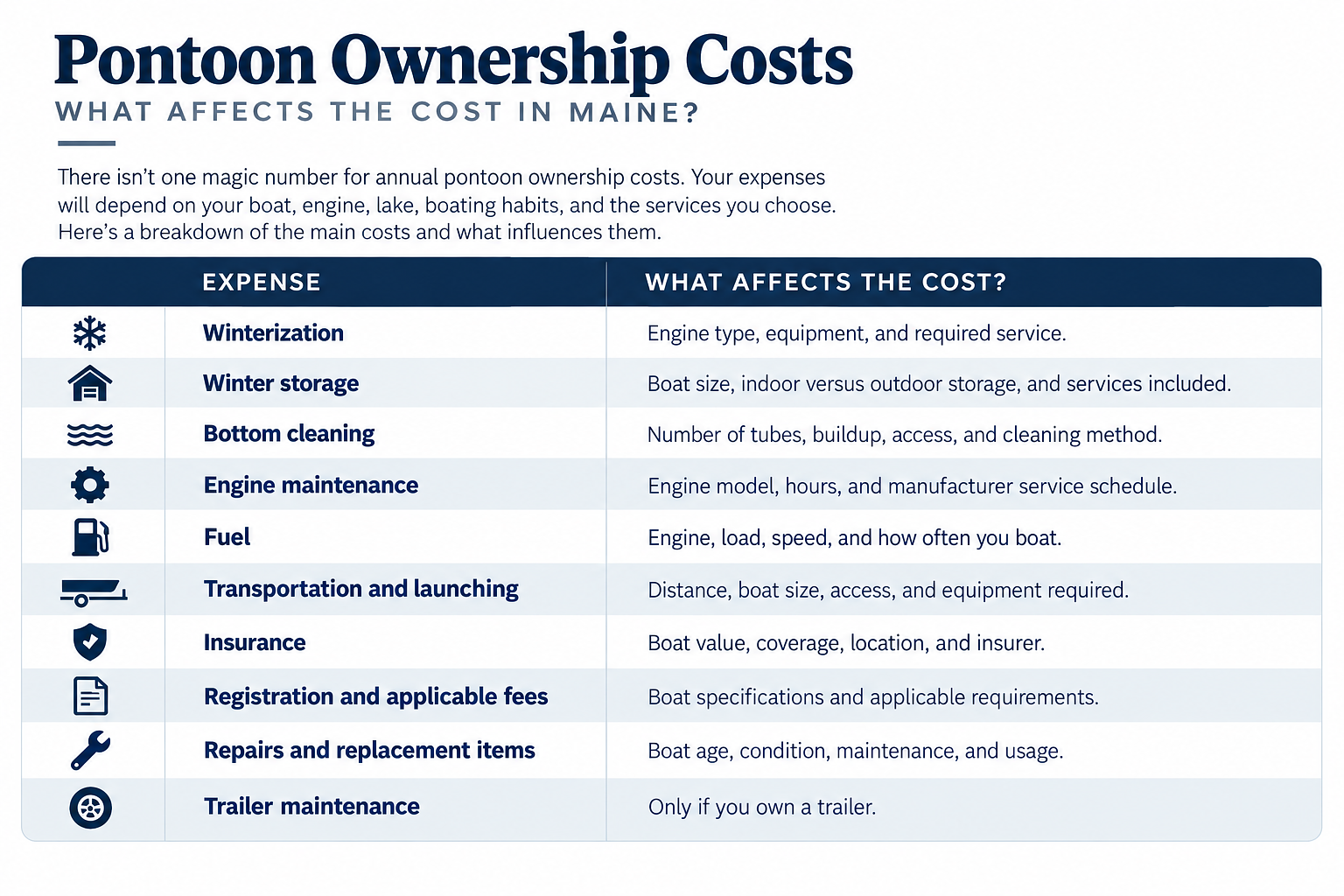
I would also leave a little room in the budget for unexpected repairs or replacing worn equipment.
Because it's a boat.
And after 45 years, I can assure you that boats occasionally have opinions of their own.
But here's the good news.
Owning a boat doesn't have to be financially unpredictable.
When you purchase something appropriate for your needs, understand your annual expenses, and keep up with maintenance, you can make boating a whole lot more manageable.
And that's what I want for our customers.
The Right Boat Should Make Your Life Better, Not More Complicated.
I think sometimes we get so caught up in comparing specifications, horsepower ratings, floor plans, and options that we forget why anybody buys a boat in the first place.
It's supposed to be fun.
It's supposed to be the place where your family gets together.
Where you unplug from the rest of the world.
Where the grandchildren learn to swim.
Where you spend a quiet evening cruising around the lake with somebody you love.
The boat shouldn't become another source of stress.
And I certainly don't want unexpected ownership expenses to take away from the experience.
That's why I believe in being upfront about the realities of owning a pontoon.
The cleaning.
The storage.
The maintenance.
The occasional repair.
And the importance of buying the right boat in the first place.
Because when you understand those things, you can make better decisions.
And better decisions tend to lead to happier boat owners.
The best boat isn't necessarily the biggest, fastest, fanciest, or most expensive. It's the one that fits your life—and lets you enjoy being on the water for years to come.
Let's Find a Pontoon That Makes Sense for Your Family.
At Clark Marine, we've been helping Maine families enjoy the water since 1958.
And after representing Avalon Pontoons since 1998, we've developed a pretty good understanding of how these boats perform, age, and fit into people's lives.
Whether you're shopping for a pontoon on Cobbosseecontee Lake, the Belgrade Lakes, Maranacook, Sebago, Moosehead, or one of Maine's many smaller ponds, we'd love to help you understand your options.
We'll talk about size, horsepower, pontoons, steering, storage, maintenance, and all the other things that make a difference over the life of your boat.
And if I can save you money on something you don't need?
Wonderful.
I'd much rather have you come back fifteen years from now and tell me how much you love your boat than sell you something today that doesn't make sense.
That's how I believe this business should work.
Explore Avalon Pontoons at Clark Marine, or come visit us in Manchester, Maine.
And if you have questions about what a particular boat is going to cost you to own?
Please ask.
I'd much rather have that conversation now.
— Rob Brown, Master Marine Technician, Clark Marine
Frequently Asked Questions About Pontoon Ownership Costs
How much does it cost to own a pontoon boat each year?
Annual pontoon ownership costs vary based on boat size, engine, winter storage, fuel usage, maintenance, insurance, and transportation. Maine pontoon owners should budget for winterization, storage, periodic engine service, bottom cleaning when needed, and other recurring expenses.
Is a tritoon more expensive to maintain than a pontoon?
A tritoon can be more expensive to maintain, particularly when it comes to bottom cleaning because it has three flotation tubes instead of two. Larger tritoon packages may also involve more expensive storage, transportation, and engine maintenance.
Do I need a trailer for my pontoon boat?
Not necessarily. If your pontoon stays at a dock throughout the boating season and you use professional launching, hauling, and storage services, owning a trailer may be unnecessary. However, owners who frequently travel between lakes will generally benefit from having an appropriately rated trailer.
Does a bigger outboard cost more to maintain?
It can. Higher-horsepower outboards may have different oil capacities, service requirements, replacement parts, and fuel consumption characteristics. The actual costs depend on the specific engine and how it's used.
Is indoor storage better for a pontoon in Maine?
Indoor storage offers protection from direct exposure to winter weather, but properly prepared outdoor storage can also be appropriate. The best choice depends on the boat, its equipment, how it's protected, and the owner's priorities.
How often should a pontoon boat be serviced?
Follow the engine and boat manufacturers' maintenance schedules, which may specify service intervals based on engine hours or elapsed time. Seasonal inspections and winter preparation are particularly important in Maine.
Should I buy a pontoon or tritoon to save money?
A traditional two-tube pontoon can be the more economical choice when it meets your family's performance, capacity, and boating needs. But purchasing an underpowered or undersized boat can lead to costly changes or an earlier trade. Choose based on how you'll actually use the boat.
What is the best value Avalon pontoon?
Rob frequently recommends starting with the Avalon LSZ because it offers a versatile foundation for many families. The best configuration depends on the lake, floor plan, engine, desired features, and long-term ownership priorities.