Pontoon Boat Features I'd Buy, Skip, or Argue With My Family About: 45 Years of Unfiltered Advice

Pontoon Boat Features I'd Buy, Skip, or Argue With My Family About: 45 Years of Unfiltered Advice
Rob's Boat Buyer's Guide | Part 5
By Rob Brown, Master Marine Technician | Over 45 Years in the Marine Industry
I've spent more than 45 years working on boats.
In that time, I've developed a few opinions.
Some are quite strong.
And according to my family, I have absolutely no intention of keeping any of them to myself.
Now, I don't see the problem with this.
After decades of selling, repairing, servicing, and operating boats, I've learned a few things about what makes a pontoon enjoyable to own.
I've also learned that some of the most attractive features in a showroom can become the biggest headaches in a service department.
And sometimes, the things that look downright boring are exactly what you should be buying.
At Clark Marine, we've represented Avalon Pontoons since 1998. We've watched these boats evolve from relatively simple floating platforms to beautiful, sophisticated machines.
Some of those changes have been wonderful.
Others?
Well, I've got some thoughts.
Just because you CAN put something on a pontoon doesn't mean you SHOULD.
Quick Reference: Rob's Pontoon Boat Dos and Don'ts
Don't feel like reading all 19 of my opinions? My family would understand.
Here's the abbreviated version.
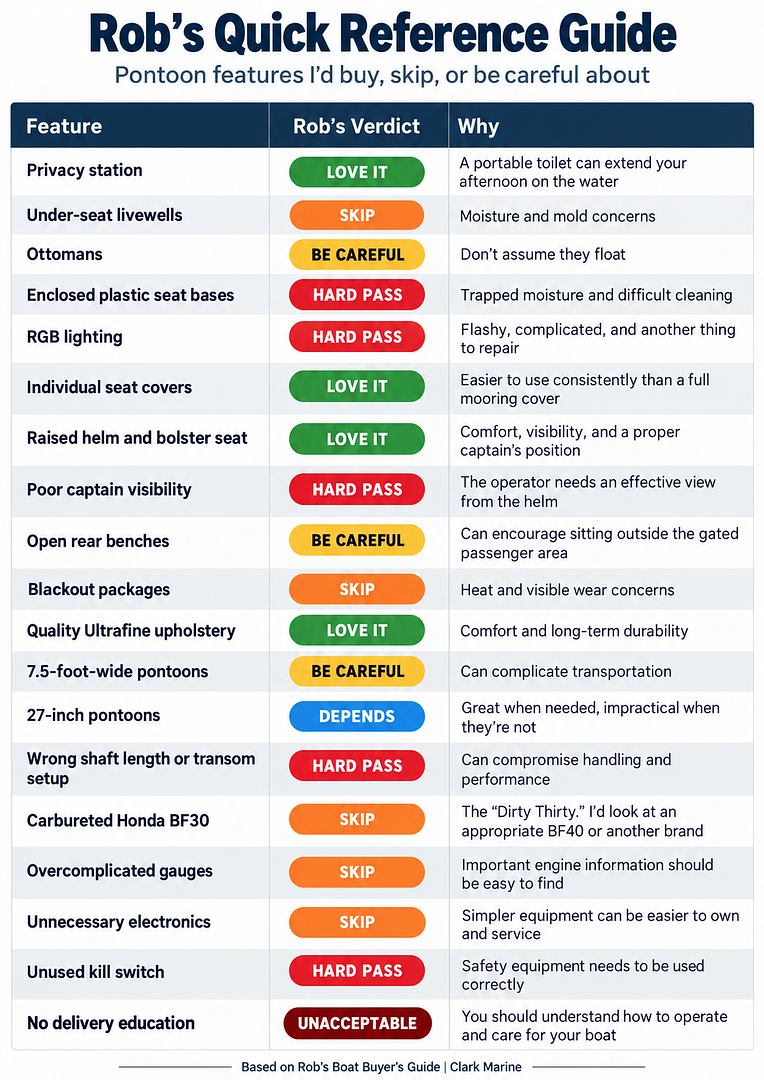
My overall philosophy: Buy the features that improve your boating experience. Skip the things that make your life more complicated. And never compromise on safety.
Now, for those of you who want the explanations, I've got a few.
1. Privacy Stations: The Feature That Can Save Your Afternoon.
Let's begin with something that isn't particularly exciting.
A privacy station.
Now, I know.
You're shopping for a beautiful new Avalon, and here I am talking about portable toilets.
But bear with me.
If you've got children, grandchildren, or guests aboard, having a private space to change clothes or accommodate a portable toilet can be incredibly useful.
And here's why I like them.
A privacy station can extend the amount of time you actually get to enjoy your boat.
You're having a wonderful afternoon on Great Pond.
The weather is perfect.
Everybody is enjoying themselves.
And then somebody needs to use the bathroom.
Suddenly, you're thinking about heading back to shore.
For some families, a privacy station and properly secured portable toilet can make the difference between ending the afternoon and staying out for another couple of hours.
Do you need one?
Not necessarily.
But for families who spend long days aboard, I think they're worth considering.
Sometimes the most valuable features aren't glamorous.
They're simply convenient.
2. Under-Seat Livewells: Water and Upholstery Aren't My Favorite Combination.
Now we're moving into an area where my service experience influences my opinions.
Livewells.
I understand why people want them.
If you're fishing from your pontoon, having a place to keep bait or fish can be useful.
But I'm not a particularly big fan of livewells tucked underneath upholstered seating.
Why?
Moisture.
And what happens when you have moisture sitting in an enclosed area without adequate ventilation and cleaning?
You can end up with mold, mildew, and odors.
We've seen enough moisture-related problems over the years to make me skeptical of designs that put wet compartments directly underneath furniture.
Now, properly engineered livewells have drainage, plumbing, and intended operating procedures. They aren't automatically a problem.
But if you're considering one, I'd want to understand exactly how it drains, how it's ventilated, and how easily you can clean and inspect the surrounding area.
If you're an avid fisherman who genuinely needs a livewell, that's a perfectly reasonable conversation.
But if you're buying a family cruising pontoon and simply think having one sounds neat?
I'd probably suggest spending your money somewhere else.
3. Ottomans: Let's Clear Up Something About Flotation.
Here's a little detail that may surprise some pontoon owners.
A removable ottoman is not automatically a flotation device.
I've encountered people who assume that because an ottoman has buoyant material or looks like a floating cushion, it will float safely if it goes overboard.
Then it sinks to the bottom of Cobbossee and is suddenly my fault....
Don't assume that.
Some are heavy enough, or constructed in ways, that they may sink.
Others may float but aren't designed to support a person in the water.
Either way, an ottoman is furniture, not life-saving equipment.
If you love the extra seating, storage, or convenience of an ottoman, wonderful.
Just use it for what it was designed to do.
And don't assume anything on your boat floats unless the manufacturer actually says it does.
4. Plastic-Box Seat Frames: This One Drives Me Absolutely Crazy.
Now we're getting into a subject that my family knows better than to bring up unless they've got some extra time.
Plastic-box seat construction.
I hate poorly designed enclosed plastic seat bases.
And I mean that.
Here's why.
Depending on how they're built, enclosed seat bases can trap moisture underneath the furniture.
And when that happens, mold and mildew can develop in spaces that are difficult to access and clean.
You might be able to wipe down the seats beautifully.
You might be able to clean the visible surfaces.
But what about the areas you can't reach?
What about the space underneath the plastic structure?
How are you supposed to properly clean and dry something you can't access?
I don't care how attractive the furniture looks on delivery day if the construction is going to make maintenance difficult down the road.
Now, not every molded seat base has this problem. Drainage, ventilation, access, and construction details matter.
But I've seen enough designs that trap moisture to make me very particular.
If something is going to get wet, I want to be able to clean it, inspect it, and dry it.
I don't think that's asking too much.
Apparently, some designers disagree.
5. RGB Lighting: Just Because It Changes Colors Doesn't Mean I Want It.
Oh, boy.
Here we go.
RGB lighting.
You know what I'm talking about.
The lights that change colors.
Blue.
Red.
Purple.
Green.
And whatever combination makes your pontoon look like a nightclub has opened in the middle of the lake.
My family thinks some of these lighting packages look fantastic.
And I suppose they're entitled to that opinion.
Personally?
I'm not interested.
I find elaborate RGB lighting packages expensive, distracting, and frequently unnecessary.
And there's another reason I don't love them.
Every additional electrical component is another thing that may eventually require diagnosis or repair.
Controllers, connectors, wiring, lighting modules, switches.
Now, I'm not saying every RGB system is unreliable.
A properly installed system can work very well.
But my experience has taught me to be cautious about paying extra for complicated features whose benefits are mostly decorative.
Especially when those features can become frustrating to maintain.
I'd rather have a boat with useful, reliable lighting and fewer unnecessary complications.
If I want to see colorful lights, I'll go find a Christmas tree.
6. Seat Covers vs. Mooring Covers: Give Me the Ones You'll Actually Use.
I'm a big believer in protecting pontoon furniture.
Replacing upholstered seats isn't cheap.
And leaving them exposed to sunshine, weather, and debris year after year isn't going to do them any favors.
So yes, I strongly recommend appropriate covers.
But here's where I have another opinion.
I generally prefer individual seat covers over large mooring covers for everyday use.
Why?
Because they're easier to handle.
And I've learned something very important about boat owners.
People are much more likely to consistently use something that's convenient.
A large mooring cover can provide substantial protection, but it may also require more time and effort to install, remove, fold, and store.
And if using it turns into a major production every time someone wants to go boating?
Well, there's a decent chance it'll spend more time in a storage compartment than on the boat.
I like individual seat covers because they're relatively straightforward to use.
You can protect the furniture without turning the end of every boating day into a wrestling match with an enormous piece of fabric.
Now, that doesn't mean a mooring cover is never the right choice.
Some owners have very good reasons to use one.
And seat covers don't necessarily provide the same protection to the deck or other exposed areas.
But for everyday furniture protection, I love the simplicity of individual seat covers.
The best cover is the one that gets used properly and consistently.
7. Raised Helms and Bolster Seats: Let the Captain Feel Like the Captain.
Finally, something I absolutely love.
Raised helm stations.
And bolster seats.
There's something about a thoughtfully designed raised helm that I really appreciate.
It gives the captain a distinguished operating position.
And I think that's appropriate.
You're not just another passenger sitting in the furniture.
You're the person responsible for operating the boat.
A well-designed raised helm can improve the captain's perspective, while a bolster seat can provide additional seating-position flexibility.
And I like that.
I want the helm to feel purposeful.
Comfortable.
Well organized.
Designed for the person who's actually operating the boat.
Now, there's one very important condition.
The captain still needs a clear view in every direction.
Which brings me to one of my biggest safety complaints.
8. If the Captain Can't See 360 Degrees, We Have a Problem.
I do not like pontoon layouts that obstruct the captain's visibility when passengers are seated.
And I really don't like boats where the captain has to stand up just to see around the furniture or the people aboard.
The operator needs to be able to maintain an effective lookout.
That includes looking forward, to the sides, and behind the boat as conditions require.
A captain should be able to see and navigate comfortably from the normal operating position.
And if the helm requires a little extra height or a different seating arrangement to accomplish that?
Then that's what we need to discuss.
Now, no boat provides literally unobstructed sightlines in every possible direction, and operators still need to turn, scan, and use appropriate precautions.
But I want the layout to make maintaining a proper lookout easier—not harder.
The furniture should be designed around safe operation, not the other way around.
I don't care how comfortable the lounge seats are if they interfere with the captain's view.
That's not something I'm willing to overlook.
9. Open-Back Floor Plans and Rear Benches: Think About Where People Will Sit.
Let's talk about floor plans.
I know people love the open feeling of certain aft arrangements.
And I understand why.
They create attractive entertaining spaces and convenient access to the rear of the boat.
But I have concerns about layouts that make it appealing for passengers to sit outside the protective gates while the boat is moving.
In particular, I'm not a big fan of certain rear-bench configurations that encourage people to gather behind the gated passenger area.
Here's why.
People will use furniture in the way it naturally invites them to use it.
If there's a beautiful bench facing the water at the back of the boat, somebody is going to want to sit there.
And if that seating location is outside the area approved for occupancy while underway, that becomes a serious concern.
Passengers should use only the seating positions designated and permitted by the boat manufacturer for the current operating conditions.
I don't want to sell somebody a floor plan that encourages unsafe habits.
And I especially don't want families with young children or pets feeling like they need to constantly worry about where everybody is sitting.
I'm also a fan of higher perimeter walls and thoughtfully designed gates when appropriate.
Again, those features don't replace supervision, life jackets, or proper operating practices.
But I appreciate boat designs that help people make safer decisions naturally.
A great floor plan should work with your family, not create unnecessary risks.
10. Blackout Packages: They Look Cool. I'm Still Not Buying One.
I know blackout packages are popular.
Black rails.
Black trim.
Black accents.
Dark upholstery.
A dramatic-looking boat.
And I'll admit, some of them are beautiful.
But here's my concern.
Dark exterior surfaces can become quite hot in direct sunshine.
And depending on the finish and material, scratches, scuffs, fading, or other wear can become especially noticeable.
That's not true of every finish, of course.
But it's something I'd want buyers to consider.
Personally, I prefer classic, solid colors.
Give me a beautiful maroon.
Sage green.
Navy blue.
A timeless color combination with an interior that looks inviting and will age gracefully.
We've sold an awful lot of champagne-and-buckskin pontoons over the years.
Often with a Honda 115, a comfortable Cruise floor plan, and a straightforward equipment package.
And you know what?
Those boats have made an awful lot of people happy.
Sometimes simple is exactly right.
11. Ultrafine Vinyl? Yes. Dark Interiors? My Family and I Are Still Fighting.
I love quality upholstery.
I've said it before, and I'll say it again.
One of my favorite Avalon options is upgraded Ultrafine vinyl.
I appreciate good furniture materials, especially when someone plans to own a boat for many years.
But when it comes to colors?
I have some preferences.
White.
Buckskin.
Light, classic interiors.
Now, my family loves some of the darker upholstery combinations.
And I will acknowledge that they can look absolutely beautiful.
I once owned a boat with a dark interior and loved it.
My family brings this up every chance they get.
Apparently, it's supposed to prove something.
But I still prefer lighter interiors.
And while heat-reflective upholstery technologies such as Koolfab may offer advantages, I'm always interested in long-term durability and serviceability as well as immediate comfort.
I'm not saying a dark interior or newer material is inherently wrong.
I'm saying I have preferences informed by experience.
And after 45 years, I think I've earned the right to be a little stubborn.
12. Seven-and-a-Half-Foot-Wide Pontoons: Sometimes Narrow Creates More Problems Than It Solves.
Here's something people may not think about when they're comparing pontoon sizes.
Width.
A narrower boat can be useful for certain applications.
Some docks, waterways, storage areas, and launch sites make a narrow beam attractive.
But I'm not automatically enthusiastic about 7.5-foot-wide pontoons.
Why?
Because of transportation.
Some of the lift-style equipment we use for handling and transporting pontoons isn't suitable for certain narrow-beam configurations.
That can mean a customer needs a dedicated bunk trailer designed specifically for their boat.
And suddenly, we've created an additional expense.
Now, that doesn't mean every 7.5-foot pontoon requires its own trailer. Equipment compatibility depends on the particular hull and transportation system.
But it's absolutely something I want to discuss before a customer buys.
If you've got a narrow landing or some other reason to choose that size, we can work through the options.
We've helped customers with challenging access situations before, and sometimes a narrower boat is exactly the right solution.
But I don't want anybody discovering after delivery that their boat is considerably more complicated to transport than they expected.
A boat needs to work at your dock, on your lake, and when it's time to take it out of the water.
13. Twenty-Seven-Inch Pontoons: Bigger Isn't Automatically Better.
I don't dislike 27-inch pontoon tubes.
Let's get that straight.
They can be useful in the right application, and I'm not opposed to them simply because they're larger.
But I also don't think everybody needs them.
Larger pontoons can change flotation characteristics, boat height, weight, trailer requirements, and transportation considerations.
And depending on the configuration, that can make a boat less practical for certain customers.
I'm more interested in whether the tubes are appropriate for the boat's intended purpose.
If a 27-inch package makes sense for the hull, engine, load, and conditions, wonderful.
But I don't want somebody buying it simply because larger sounds more impressive.
You may be noticing a theme here.
Bigger isn't always better. Better is better.
14. Twenty-Inch Outboard Shafts and Poor Transom Geometry: Don't Get Me Started.
Now we're getting into something that really matters to me as a technician.
How the outboard is mounted.
And frankly, I don't think buyers pay nearly enough attention to it.
I've seen boats with tremendous potential that never performed as well as they should have because the engine installation and hull configuration weren't working together.
The length of the outboard shaft, the transom height, the motor mounting position, the propeller, and the way water moves around the pontoons all matter.
I'm particularly skeptical of 20-inch-shaft outboard configurations on many modern pontoons.
And here's something we've learned through our work at Clark Marine.
On the 25-inch-tube pontoon configurations we've worked with, we've had excellent results with appropriately designed approximately 23-inch transom arrangements matched to 25-inch-shaft outboards.
We've found that getting that relationship right can make a noticeable difference in how a boat turns, accelerates, and handles.
And when it's wrong?
You can encounter propeller ventilation, loss of grip in turns, poor acceleration, and disappointing overall performance.
People sometimes call these problems cavitation, although true cavitation and ventilation are different phenomena.
Either way, the customer ends up with a boat that isn't performing as well as it should.
And I don't like that.
Now, I wouldn't suggest that one transom measurement should be applied universally to every pontoon, tritoon, outboard, or hull design.
The manufacturer's approved specifications, actual mounting height, water flow, engine setup, and on-water testing all matter.
But the lesson I've learned is this:
The relationship between the engine and the hull is enormously important.
Especially on higher-performance boats.
If you've spent good money on a properly engineered pontoon or tritoon, I want you getting the performance it's capable of delivering.
I don't want its potential compromised by an inappropriate engine installation.
15. The Dirty Thirty: Why I Would Pass on the Carbureted Honda 30.
Oh, the Dirty Thirty.
If you've spent much time around our service department, you may have heard me use that expression.
And to be clear, I'm talking specifically about the carbureted Honda BF30 outboard.
I actually have a great deal of respect for Honda engines. We've sold and serviced them for years, and some of my favorite pontoon packages have included Honda 115s.
But the Honda 30?
I'd rather choose something else.
Here's why.
It's the Carburetors That Bother Me.
The Honda BF30 uses three carburetors rather than electronic fuel injection.
And if there's one thing I've learned after decades working on outboards, it's that fuel-system maintenance matters tremendously.
Especially in Maine, where engines may spend significant portions of the year sitting unused.
Carburetors have small fuel passages and components that can become restricted by deposits associated with deteriorating or contaminated fuel.
And when that happens, the result can be rough running, difficult starting, poor performance, or additional service work.
At Clark Marine, fuel-system problems are the number one engine issue we encounter during the summer.
So when I'm recommending a new outboard package, I pay close attention to the fuel-delivery system.
What Would I Buy Instead?
If the boat is appropriately rated and the customer needs that general horsepower range, I'd rather explore the fuel-injected Honda BF40.
Or I'd consider an appropriately sized fuel-injected outboard from another manufacturer.
The Honda 40 offers a different engine platform with electronic fuel injection, and that makes it a more appealing choice to me for many applications.
Now, fuel injection doesn't mean an engine is immune to bad fuel.
It certainly isn't.
Fuel-injected engines still need appropriate maintenance, fresh fuel, and proper storage practices.
And a Honda BF30 that's properly maintained can certainly provide years of service.
But when I'm choosing a boat-and-motor package from the beginning?
I'm inclined to pass on the carbureted Honda 30 and look at a suitable fuel-injected alternative.
The Dirty Thirty can stay off my order sheet.
My family can tell you that's one opinion I don't expect to change anytime soon.
16. Gauges: Give Me Information I Can Actually Use.
Here's something I think engine manufacturers could do a much better job with.
Instrumentation.
I like gauges that make sense.
I like information that's easy to find.
And I want the captain to understand the condition of the engine without having to navigate six different menus.
When I'm operating a boat, I want clear, reliable information.
Engine speed.
Fuel information.
Warnings.
And when available, operating temperature.
Why Don't More Outboards Have a Proper Temperature Gauge?
This one genuinely bothers me.
An operating-temperature display can provide useful information about how an engine is behaving.
And after decades of diagnosing cooling-system problems, I'd love to see clear temperature information become more widely available as standard equipment.
Now, not every outboard measures or displays temperature in the same way, and a gauge by itself won't identify every cooling problem.
Engine alarms and warning systems remain important.
But I believe an accurate, easy-to-understand temperature display can be a valuable part of the operator's information.
If there's something important happening inside my engine, I want to know about it.
And I don't want to spend five minutes interacting with a screen just to find basic information.
A beautiful display that makes essential information difficult to access isn't an improvement in my book.
17. Don't Buy Technology Just Because It Looks Impressive.
This is my philosophy on digital controls, lighting packages, screens, and almost every other electronic feature offered on a modern boat.
I don't hate technology.
I hate unnecessary complexity.
I particularly dislike expensive, flashy features that create additional failure points without meaningfully improving the boating experience.
A mechanical throttle-and-shift system can be a wonderful choice when compatible with the engine and application.
Digital controls have legitimate advantages, too.
And modern electronics can be extremely useful.
But I want to understand the benefit.
What does this feature actually do for the customer?
Does it make operating the boat easier?
Does it improve useful information?
Does it increase comfort?
Does it solve a problem?
And what happens when it stops working?
Because here's the thing.
The people who sell complicated features don't always have to be the people who fix them.
We do.
At Clark Marine, we're a service dealership as well as a sales dealership.
We see what happens five, ten, and fifteen years after a boat leaves the showroom.
And that gives us a perspective I think is worth sharing.
18. There's No Point Having a Kill Switch If You Don't Use It.
Now we're going to talk about something that isn't an opinion.
Safety.
A properly functioning engine cut-off switch is designed to stop the motor if the operator becomes separated from the helm.
But it can't provide that protection if the required lanyard or link isn't attached to the operator.
I've seen people treat kill-switch lanyards like decorative accessories.
They hang there.
They look important.
And nobody actually uses them.
That defeats the purpose.
On boats covered by the federal engine cut-off switch requirement, the operator must use the link when operating on plane or above displacement speed, subject to the law's exceptions.
And regardless of the legal requirements that apply to a particular boat, I strongly encourage people to understand and properly use their safety equipment.
If you're counting on a safety device to protect you, you have to actually use it.
Simple as that.
19. The Most Important Pontoon Feature Isn't Something You Buy.
After all of this, I want to leave you with something I believe more strongly than any opinion about upholstery, electronics, engine size, or floor plans.
The worst pontoon boat is the one you don't know how to use.
I don't care how beautiful it is.
I don't care how much horsepower it has.
I don't care how impressive the technology is.
If you don't know how to operate it, care for it, and handle it safely, we've missed the most important part of the buying process.
And I believe the dealership has a responsibility to help you learn.
Buying a Boat Shouldn't End With Writing a Check.
When somebody buys a boat from Clark Marine, our job isn't simply to finish the paperwork, arrange financing, hand over the keys, and wave goodbye.
That's not good enough.
We want our customers to understand what they've purchased.
We want them to know how to operate the boat confidently.
We want them to understand the systems, the controls, the maintenance requirements, and the safety equipment.
And we want to make sure everyone who's going to operate the boat has an opportunity to learn.
That's why we spend approximately two to three hours with our customers on delivery day, providing orientation and education both on land and on the water.
We go over how the boat operates.
We explain its features.
We discuss safety.
We demonstrate the equipment.
And we answer questions.
Lots of questions.
Sometimes the customer is an experienced boater.
Sometimes it's their very first boat.
Sometimes one spouse has been boating for 40 years while the other has never operated a boat.
That's exactly why I think this matters so much.
Everyone who will regularly operate that boat deserves the opportunity to feel comfortable and confident behind the wheel.
And I want customers to feel comfortable asking us questions after delivery, too.
Because education doesn't stop the moment they leave our dealership.
The Goal Is for You to Have Fun.
When a family comes to Clark Marine, I want them to feel understood.
I want them to know what they're buying.
I want them to understand the realities of owning it.
And I want them to feel cared for long after they've taken delivery.
We work hard to take the uncertainty out of boating.
That's why we spend so much time on orientation.
That's why we ask so many questions during the sales process.
And that's why I've spent the last five articles explaining things that most customers probably never expected a boat dealer to talk about.
Because at the end of the day, I want you to be able to get on your boat and enjoy yourself.
Not worry about whether you understand the controls.
Not wonder what that warning light means.
Not struggle with a floor plan that doesn't work for your family.
And certainly not discover that nobody ever taught you how to use the boat you just purchased.
My Final Advice After 45 Years in the Marine Industry
I've watched boats change tremendously over the course of my career.
I've seen wonderful innovations.
I've seen some questionable ones.
I've watched manufacturers come and go, engines evolve, and pontoons become more sophisticated than anyone could have imagined when I started working in this industry.
But the fundamentals haven't changed nearly as much as you might think.
I still want a well-built boat.
I still want the right horsepower.
I still want comfortable, predictable handling.
I still want quality materials and features that are practical to maintain.
I still want the captain to see where they're going.
And I still want the people aboard to feel safe and comfortable.
I don't need every flashy feature available.
And I don't think you do, either.
But I do want you to have the things that genuinely improve your experience.
And I want you to understand the boat well enough to enjoy it confidently.
Because after more than 45 years working on boats, I believe something very simple:
The best boat isn't the one with the most features. It's the one you understand, trust, and genuinely love using.
And if we can help you find that boat, I think we've done our job.
Come Talk Boats With Us. Opinions Are Included.
Clark Marine has been helping Maine families enjoy boating since 1958, and we've represented Avalon Pontoons since 1998.
We help customers throughout the Winthrop Lakes region, Cobbosseecontee Lake, Maranacook, the Belgrade Lakes, Augusta, Waterville, Sebago, Moosehead, and beyond find boats that fit their needs.
We'll help you compare Avalon models, floor plans, horsepower, steering, construction, and equipment.
We'll tell you what we like.
We'll tell you what we're skeptical about.
And we'll explain why.
Because our goal isn't to sell you the most expensive pontoon on the lot.
Our goal is to put you in a boat you're going to love for years to come—and make sure you know exactly how to enjoy it.
Explore Avalon Pontoons at Clark Marine, or come see us in Manchester, Maine.
And if you want to talk about RGB lighting, plastic-box seat frames, or dark upholstery?
Well.
You might want to clear your schedule.
— Rob Brown, Master Marine Technician, Clark Marine
Frequently Asked Questions About Pontoon Features and Upgrades
What pontoon boat upgrades are actually worth it?
Rob recommends prioritizing good steering, appropriate horsepower, quality upholstery, practical protective features, and a helm with clear visibility. Convenience upgrades are worth considering when they improve how your family actually uses the boat.
Are plastic pontoon seat bases bad?
Not necessarily. Molded seat bases vary by design. Rob is particularly cautious about enclosed bases that trap moisture and make cleaning and inspection difficult. Good drainage, ventilation, and maintenance access are important.
Are individual pontoon seat covers better than a mooring cover?
Individual seat covers can be easier to install and remove, which may encourage more consistent use. A full mooring cover may offer broader protection, so the best choice depends on how the boat is stored and used.
Is a raised helm worth it on a pontoon?
A raised helm may improve the operator's viewing position and create a more comfortable captain's area. The seating arrangement must still provide adequate visibility in normal operating conditions.
What size outboard shaft should a pontoon have?
The correct outboard shaft length and mounting height depend on the hull, transom, engine, and manufacturer specifications. Clark Marine has had strong results with certain 25-inch-tube pontoon configurations using approximately 23-inch transoms and appropriately matched 25-inch-shaft outboards, but those dimensions aren't universal requirements.
Why does Rob call the Honda BF30 the Dirty Thirty?
Rob's nickname reflects his reservations about the BF30's carbureted fuel system. The Honda BF30 uses three carburetors, which can require attention when fuel quality or storage practices lead to deposits or restrictions. Rob prefers considering a suitable fuel-injected Honda BF40 or another appropriate fuel-injected outboard.
Is the Honda BF40 fuel injected?
Yes. The current Honda BF40 uses programmed electronic fuel injection. That is one reason Rob prefers considering it over the carbureted BF30 when the boat's horsepower rating and intended use make the BF40 appropriate.
Are RGB lights worth adding to a pontoon?
RGB lighting is primarily a personal-preference upgrade. Rob prefers simpler systems and puts greater priority on useful lighting, serviceability, and equipment that contributes directly to the boating experience.
Are narrow 7.5-foot pontoons harder to transport?
They can be with certain transportation equipment. Some lift-style trailers are incompatible with specific narrow-beam or hull configurations, making a suitable bunk trailer or alternate transport arrangement necessary.