
How Much Does It REALLY Cost to Repower a Boat? Suzuki vs. Mercury Pricing Explained

Thinking about replacing your old 2-stroke outboard with a new 4-stroke? We're breaking down real Suzuki and Mercury repower prices for 60HP, 115HP, 150HP, and 250HP motors.
By Amy | Clark Marine, Maine's Freshwater Repower Center | October 2026
Let's talk about money.
Specifically, let's talk about how much it actually costs to take that old 2-stroke motor off the back of your boat and replace it with a brand-new 4-stroke outboard.
Because if you've ever tried to research the cost of a boat repower, you've probably noticed something frustrating.
Finding the price of an outboard motor? Pretty easy.
Finding out what it will actually cost to get that motor installed, rigged, and ready for the water?
Well, that's another story.
At Clark Marine, we specialize in freshwater outboard repowers, particularly Suzuki and Mercury. We work with boaters throughout Maine who love their boats but are ready to say goodbye to aging, unreliable, or inefficient motors.
So I decided to sit down, run some actual quotes, and compare four popular horsepower categories.
And the results were pretty interesting.
In every 2-stroke-to-4-stroke comparison I ran, Suzuki came out less expensive than Mercury.
But before all you Mercury fans come after me, hang on.
Because that doesn't necessarily mean Suzuki is the better motor for you.
Let's get into it.
Suzuki vs. Mercury Repower Prices: A Real-World Comparison
For this comparison, I looked at four popular outboard horsepower categories: 60HP, 115HP, 150HP, and 250HP.
These quotes were prepared on October 22, 2026, using applicable manufacturer promotions for qualifying 2-stroke-to-4-stroke repowers.
We're not just comparing the price of the engines themselves. We're looking at the estimated cost of the complete repower, including rigging and installation.
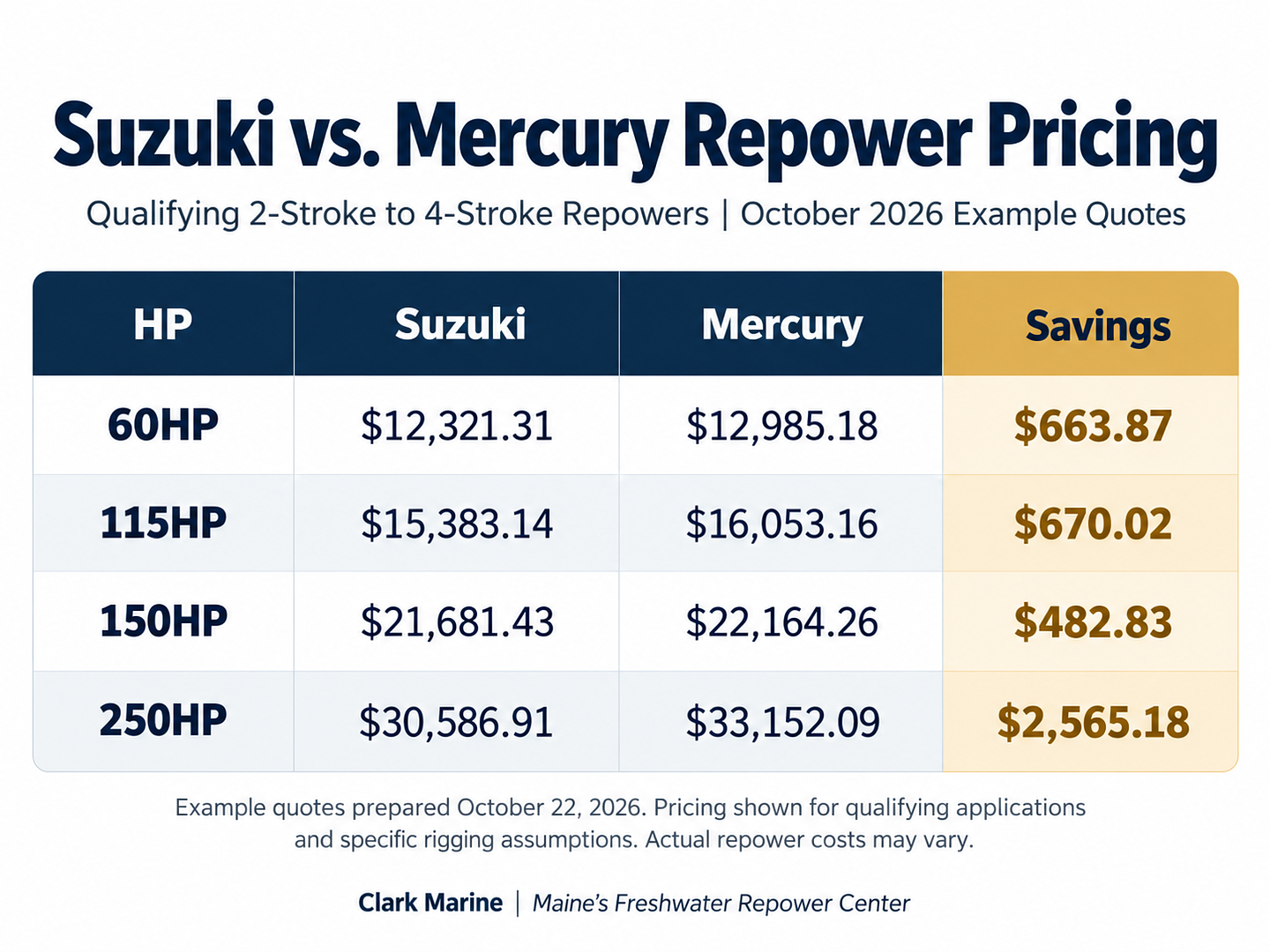
Important: These are October 2026 promotional examples, not guaranteed prices for every boat. Your actual repower cost will depend on your existing equipment, rigging requirements, boat configuration, program eligibility, and available promotions.
Now let's break these numbers down.
60HP Repower Cost: Suzuki vs. Mercury
Let's start with the smaller motors.
For this comparison, we looked at 60HP long-shaft outboards.
The Mercury engine itself was quoted at $8,305, while the Suzuki was $7,805.
That's a $500 difference before we even start talking about rigging!
But once we added the rigging components, installation, and applicable promotions, here's where we landed.
Suzuki 60HP repower: $12,321.31
Mercury 60HP repower: $12,985.18
That's a difference of $663.87 in Suzuki's favor.
Interestingly, Suzuki actually had slightly more expensive rigging components in this comparison. But thanks to the engine pricing and available programs, it still came out ahead.
One other thing worth considering is warranty coverage. Depending on the promotional programs available, purchasing additional warranty protection for the Mercury could increase that price difference.
My takeaway: Suzuki was the better price for this particular 2-stroke-to-4-stroke repower. But if you already have compatible Mercury rigging, we would want to look at that before making a recommendation.
115HP Repower Cost: Suzuki vs. Mercury
Next up, the 115HP category.
For this comparison, we looked at the Suzuki DF115BTL and Mercury 115ELPT.
The Suzuki engine started at $11,135, while the Mercury was quoted at $11,450.
Only $315 separated the engines themselves.
But once we completed our repower estimates, here's where we landed.
Suzuki 115HP repower: $15,383.14
Mercury 115HP repower: $16,053.16
That's a difference of $670.02 in Suzuki's favor.
Again, Suzuki came out ahead, but we're not talking about an enormous difference.
And that's important.
When you're investing more than $15,000 in a new outboard motor, a few hundred dollars shouldn't be the only thing influencing your decision.
Existing rigging, warranty coverage, familiarity with the brand, and how you use your boat should all play a role.
My takeaway: Suzuki won this comparison on price, but both motors deserve consideration. If you're already a Mercury owner, it may be worth exploring whether your existing equipment could reduce the cost of staying with Mercury.
150HP Repower Cost: Suzuki vs. Mercury
Now we're getting into a horsepower category where the manufacturer programs become especially interesting.
For this comparison, we looked at the Suzuki DF150ATL and Mercury 150ELPT.
And here's what surprised me.
The engines themselves were remarkably close in price.
The Suzuki engine was quoted at $14,555.
The Mercury engine was quoted at $14,720.
That's only a $165 difference!
But once we completed our repower estimates, here's where we landed.
Suzuki 150HP repower: $21,681.43
Mercury 150HP repower: $22,164.26
That's a difference of $482.83 in Suzuki's favor.
Now, here's where it gets interesting.
At the time of this comparison, qualifying Suzuki 150HP repowers could also take advantage of a seven-year warranty promotion.
The Mercury in our comparison included three years of factory warranty coverage.
That means you're not just comparing the purchase price. You're also comparing the warranty protection included with your investment.
And when we're talking about a purchase this significant, that absolutely deserves consideration.
My takeaway: Suzuki had a modest price advantage and an attractive warranty promotion. But with the engines priced so closely, your existing equipment and personal preferences could easily influence which repower makes the most sense.
250HP Repower Cost: Suzuki vs. Mercury
This one surprised me a little.
When we compared the Suzuki DF250TLSS with the Mercury 250ELPT, we found the widest price gap of the four categories.
The Suzuki engine was quoted at $24,040.
The Mercury engine was quoted at $25,135.
That's already a difference of $1,095 before installation.
But once we completed our repower estimates, the difference became considerably larger.
Suzuki 250HP repower: $30,586.91
Mercury 250HP repower: $33,152.09
That's a difference of $2,565.18 in Suzuki's favor.
Now we're talking about real money.
For someone replacing an aging 250HP 2-stroke with a modern 4-stroke and needing a complete new rigging package, Suzuki was the clear pricing winner in this comparison.
And that's a pretty substantial difference.
My takeaway: Suzuki offered significant savings in this particular application. If you're considering a high-horsepower repower, it's absolutely worth comparing both manufacturers before making a decision.
What Is Suzuki's 4-4-2 Repower Program?
One of the reasons Suzuki was so competitive in these comparisons is the Suzuki Four 4 Two (4-4-2) Program.
This program encourages boaters to retire older 2-stroke outboards and replace them with new Suzuki 4-stroke engines.
Qualifying customers may receive additional incentives when trading in an eligible 2-stroke outboard.
And here's where it gets especially interesting.
Depending on the current promotions, Suzuki's 4-4-2 incentives can sometimes be combined with other manufacturer rebates.
That's exactly what made Suzuki so competitive in our October 2026 comparisons.
But here's something else I really love about this program.
Your Repower Can Help Protect Maine's Lakes
At Clark Marine, our participation in Suzuki's 4-4-2 program is also connected to supporting water quality.
When we complete a qualifying repower through this program, we make a donation equal to 5% to the Friends of the Cobbossee Watershed, a local organization working to protect the waters that mean so much to our community.
I think that's pretty fantastic.
You get to enjoy a newer motor while helping support the health of the lakes we all love.
It's one more reason we're enthusiastic about the program.
Program eligibility and promotional savings are subject to current terms, so check with our team before assuming a particular rebate applies to your boat.
Wait. Does That Mean Suzuki Is Better Than Mercury?
Nope.
And I want to make that very clear.
Suzuki won our four price comparisons. That does not mean Suzuki automatically wins every repower comparison.
In fact, there are situations where I would absolutely encourage someone to stick with Mercury.
Here's why.
1. You're Replacing a Mercury 4-Stroke With Another Mercury
Our comparison focuses specifically on replacing an older 2-stroke with a new 4-stroke.
That matters because Suzuki's 4-4-2 incentives apply to qualifying 2-stroke trade-ins.
If you're replacing an existing Mercury 4-stroke with another Mercury, the financial equation can look completely different.
2. You May Be Able to Reuse Existing Mercury Rigging
This is a big one.
A complete repower can involve more than just removing one engine and installing another.
Depending on the application, you may need new controls, cables, gauges, wiring harnesses, or other rigging components.
But if your existing Mercury rigging is compatible with your new Mercury motor, you may be able to reuse some of those components.
And that can save you money.
Sometimes enough money to change which brand is the more affordable choice.
That's why we evaluate the entire boat before recommending a motor.
3. You Already Love Mercury
Let me ask you something.
If you've owned Mercury outboards your entire life, know how to operate them, trust the brand, and have been perfectly happy with their performance...
Why would I automatically try to convince you to switch?
Just because you currently have an OptiMax that needs replacing doesn't mean you should abandon a brand you've enjoyed for years.
Maybe the Mercury costs a little more.
Maybe we can offset some of that by reusing equipment.
Maybe extended warranty protection helps make the purchase feel more comfortable.
Those are all worthwhile conversations.
The best repower isn't always the one with the lowest price tag. It's the one that makes the most sense for your boat and the way you use it.
And that's exactly how we approach repowers at Clark Marine.
What Does a Boat Repower Actually Include?
This is one of the biggest sources of confusion when people shop for outboard motors.
They see a motor advertised online for a certain price and assume that's what replacing their existing engine will cost.
But the engine is only one part of the project.
Depending on your boat and the motor you're installing, a complete repower may involve:
- Removing the existing outboard
- Installing the new motor
- Replacing or adapting engine controls
- Installing compatible gauges and wiring
- Adding or replacing cables and harnesses
- Addressing steering requirements
- Selecting and installing an appropriate propeller
- Completing setup and testing
Some boats require more work than others.
And some already have equipment that can safely and appropriately be reused.
That's why two people purchasing the exact same horsepower outboard may receive different installation quotes.
We want you to understand those differences before making a decision.
Can You Finance a Boat Repower?
Yes!
And this is another area where the available manufacturer promotions can make a big difference.
At the time we filmed this comparison in October 2026, Mercury was advertising promotional financing as low as 3.99% APR for qualifying Tier 1 applicants.
Both Suzuki and Mercury also had promotional financing options around 5.99% APR for qualifying purchases.
The actual rate, term, eligibility requirements, and amount that can be financed depend on the applicable program and credit approval.
Financing can make a repower more manageable, particularly if you love your boat and would prefer to keep it rather than take on the expense of buying an entirely new one.
Want to explore your repower options?
Visit Clark Marine's Freshwater Repower Center and use our Repower Calculator to get started.
TRY THE CLARK MARINE REPOWER CALCULATOR →
Is It Worth Replacing a 2-Stroke With a 4-Stroke?
For the right boat, absolutely.
An older 2-stroke might still run, but that doesn't necessarily mean it's the right engine to keep for another five or ten years.
There are some meaningful benefits to upgrading to a modern 4-stroke outboard.
Better Fuel Efficiency
Depending on what you're replacing, a modern 4-stroke can offer improved fuel economy.
And when you spend your summers cruising Maine's lakes, those savings can add up.
Less 2-Stroke Oil Consumption
Moving from a traditional oil-burning 2-stroke to a 4-stroke eliminates the need to continuously consume 2-stroke oil during operation.
Keep in mind that 4-strokes still require scheduled oil and filter changes.
Quieter Operation
Many boaters appreciate how quiet modern 4-stroke outboards are, particularly at idle and cruising speeds.
For families who enjoy leisurely pontoon rides, conversations, and relaxing afternoons on the lake, that can make a noticeable difference.
Modern Technology and Support
A newer engine gives you access to current technology, modern manufacturer support, and warranty coverage.
And if your existing motor is becoming increasingly unreliable, that peace of mind may be the biggest benefit of all.
More Confidence on the Water
This one matters to me.
Your boat is supposed to be your happy place.
It's supposed to be where you escape the chaos of everyday life, spend time with your favorite people, and make memories.
Not where you're constantly wondering whether the motor is going to start.
Repowering isn't always the right choice, but when it is, it can make boating feel fun again.
Should You Repower Your Boat or Buy a New One?
This is a question we hear all the time.
And my answer is that it depends on the boat.
If you have a boat you genuinely love, and the hull, deck, transom, and other major components are in good condition, repowering may be worth serious consideration.
You might already have the perfect layout.
You might love how your boat handles.
Or maybe replacing the entire boat would cost considerably more than installing a modern motor.
On the other hand, if your boat has major structural concerns, a failing deck, or other expensive problems, replacing the motor alone may not be the best investment.
A new outboard doesn't magically fix every other issue with a boat.
We want to make sure you're putting your money into something worth keeping.
And sometimes that means recommending repairs, sometimes a repower, and sometimes a different boat entirely.
Our job is to help you understand those options, not push you toward the most expensive one.
Why Winter Is One of the Best Times to Repower in Maine
Here's something Maine boaters should really think about.
Why wait until spring?
If you're already putting the boat away for winter, this is an excellent opportunity to take care of a major project without sacrificing boating time.
At Clark Marine, we're open year-round.
That means we can work with you through the colder months to evaluate your existing motor, discuss your options, and plan the installation.
Instead of spending those first beautiful spring weekends trying to schedule a repower, you can work toward having your boat ready for the season.
And when manufacturer rebates, repower incentives, or winter installation promotions are available, the financial benefits can make the timing even more attractive.
Maine's Freshwater Repower Center: Why Clark Marine?
Clark Marine has been serving Maine's boating community since 1958.
We're a family-owned marine dealership in Manchester, Maine, and one of our specialties is helping freshwater boaters find the right replacement outboard motors.
Our repower team works with customers throughout the greater Augusta area, the Belgrade Lakes, Cobbosseecontee Lake, Maranacook Lake, China Lake, and other freshwater boating communities across Maine.
We specialize in Suzuki and Mercury repowers, and we can also discuss other manufacturer options depending on your application.
What makes our approach different?
We don't want to sell you a motor simply because it happens to be the least expensive.
We want to understand your boat, how you use it, what you like and dislike about your current engine, and what you want to accomplish.
Then we can help you make a decision that actually makes sense.
Sometimes that's a Suzuki.
Sometimes that's a Mercury.
And sometimes the best advice is to hold off until we've evaluated the boat more closely.
We're people taking care of people. That's how we believe a marine dealership should operate.
Frequently Asked Questions About Boat Repowering
How much does it cost to repower a boat in 2026?
In our October 2026 comparison of qualifying 2-stroke-to-4-stroke repowers, example installed prices ranged from approximately $12,321 for a Suzuki 60HP to $33,152 for a Mercury 250HP. Your actual cost will depend on horsepower, manufacturer, rigging, labor, and available incentives.
Is Suzuki cheaper than Mercury?
Suzuki was less expensive in all four of our October 2026 2-stroke-to-4-stroke comparisons. However, this is not universally true. Existing rigging compatibility, engine selection, and applicable promotions can change the total price.
Can I replace a Mercury 2-stroke with a Suzuki 4-stroke?
Potentially, yes. Switching manufacturers is possible on many boats, but the installation needs to be evaluated for compatibility, controls, steering, and other requirements.
Can I reuse my existing controls when repowering?
Sometimes. It depends on the age, type, and compatibility of your existing equipment and the replacement engine. Reusing compatible components can reduce installation expenses.
What is Suzuki's 4-4-2 program?
Suzuki's Four 4 Two program provides qualifying incentives for replacing older 2-stroke outboards with new Suzuki 4-stroke engines. Eligibility and savings depend on current program terms.
Is repowering cheaper than buying a new boat?
It can be significantly less expensive, particularly if your existing boat is in good structural condition and meets your needs. However, major structural or mechanical concerns should be evaluated before investing in a new motor.
Can I finance a new outboard motor?
Yes. Financing options may be available for qualifying customers, sometimes including promotional rates through participating manufacturers and lenders.
When should I schedule a boat repower in Maine?
Fall and winter are excellent times to plan a repower because you can address major work during the off-season instead of losing valuable summer boating days.
Ready to Find Out What Your Repower Will Cost?
Here's the good news.
You don't have to call five different dealerships, guess at installation costs, or spend hours trying to figure out which engine makes the most sense.
You can start right on our website.
Our Repower Calculator allows you to explore available engines, compare options, and get a preliminary idea of your total investment.
And if you'd rather have a conversation?
We'd love that, too.
Whether you've got an old Evinrude, Johnson, Mercury OptiMax, or another outboard that's ready for retirement, we're happy to help you explore your options.
No pressure. Just a conversation about what makes sense for you and your boat.
CALCULATE YOUR BOAT REPOWER COST →
Clark Marine — Maine's Freshwater Repower Center
Manchester, Maine
https://www.clarkmarinemaine.com
Saving vacations since 1958.
Pricing and promotion disclosure: All prices reflect example quotes prepared October 22, 2026, under specific equipment and promotional assumptions. Manufacturer rebates, Suzuki 4-4-2 eligibility, warranties, financing, availability, and installation costs may change. Contact Clark Marine for current pricing and program terms.